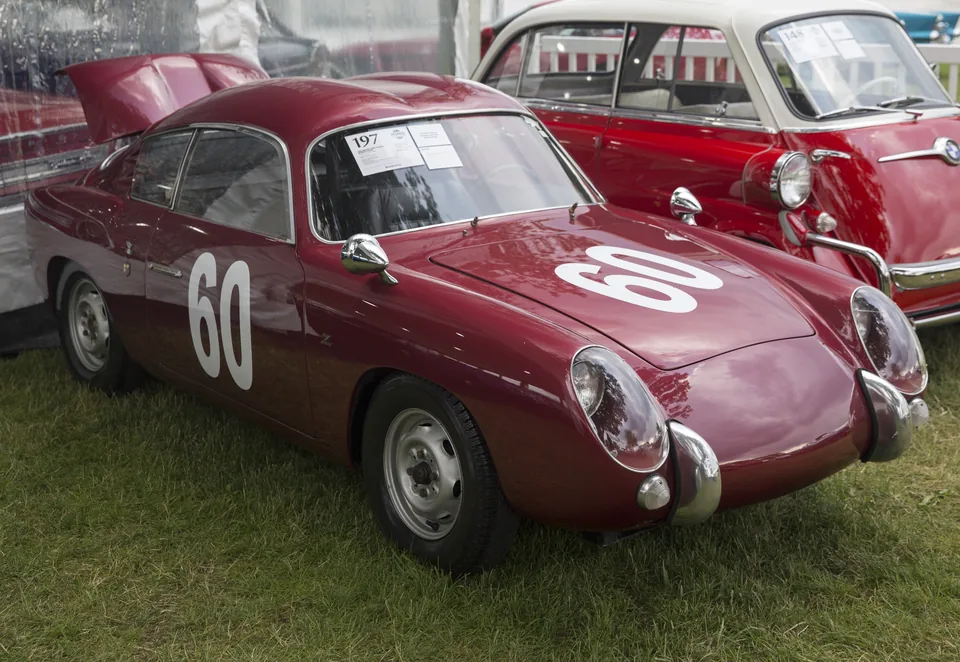
Fiat-Abarth 750 GT Zagato
Why 2.8: Zagato's aluminum body wrapped a tuned 747cc Fiat 600 four in barely 560 kg, and the twin roof bubbles were a packaging fix — the roofline was dropped so low a helmeted driver needed the bulge just to sit upright. Around 500 were built, and values have climbed roughly 55-fold since new; most now live in collections rather than on the road.
Layout
Natural habitat
Ride comfort
Sound
A 750cc pushrod four hung out the back with a straight-through Abarth exhaust and a Zagato shell too thin to absorb any of it, so the rasp carries far further than the capacity suggests. But up close it is buzzy and thin rather than deep.
4-cylinder · naturally aspirated · 7,000 rpm redline · rated 6.6 / 10 for engine sound
Market value
Median asking price, good condition · €2k (1958) → €129k (2026), trending up · illustrative data
Child seats · ISOFIX
Built before ISOFIX existed, so there are no anchor points at all. A child seat here is a seatbelt installation in the only passenger seat there is.
Derived from production years and seating layout, not a per-car source. ISOFIX was standardised as ISO 13216 in 1997, required on new EU model types from 2011 and on all new EU cars from 2014.
The long version
The double bubble wasn't styling flourish — it was Zagato solving a problem Abarth's own chassis created. Carlo Abarth wanted the roofline as low as the tiny 747cc engine would allow, and once it dropped that far a driver in a period racing helmet couldn't fit underneath it, so Zagato pressed a bubble into the aluminum roof panel over each seat to buy the missing centimeters. A prototype ran the 1956 Mille Miglia and placed second in class, and the production version that followed weighed barely 560 kg dressed in hand-formed aluminum over a tubular frame — light enough that even the base car's modest 44-47 hp felt urgent. Abarth later offered a twin-cam 'Bialbero' version making 57 hp at 7,000 rpm for buyers who wanted more theater to match the shape. Roughly 500 were built between 1956 and 1959, sold in Italy for about 1.5 million lire — call it $2,500 at the time — and for decades that's roughly what they were worth used, unglamorous Italian oddities nobody was chasing. That changed hard once the wider vintage-Zagato and Mille Miglia Storica markets discovered them: recent auction results cluster from $60,000 to well over $120,000, a return that has pulled almost every surviving example into serious collections. A handful still run the Mille Miglia's modern historic re-enactment, eligible by virtue of that 1956 debut, but most spend the year under a cover.