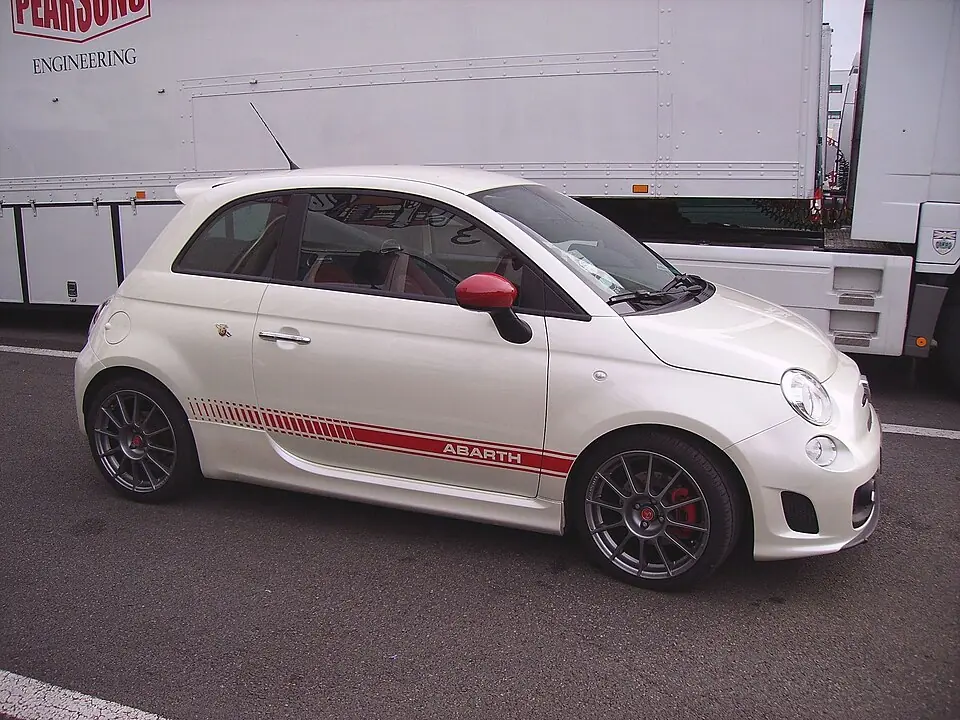
Fiat 500 Abarth
Why 8.3: Fiat's re-entry to America came with a scorpion badge and 160 hp stuffed into a car that weighs about as much as a large motorcycle. Cheap to buy, cheap to insure, driven like the city car it is underneath the exhaust note.
Layout
Natural habitat
Ride comfort
Sound
An oversized exhaust on a 1.4 T-Jet is comically loud for a city car and pops hard on lift-off, which is most of why anyone buys one. But the back box is tamer than the Record Monza car's and it is still a boosted four, so it lands just under the Competizione.
4-cylinder · turbocharged · 6,500 rpm redline · rated 6.9 / 10 for engine sound
Market value
Median asking price, good condition · €19k (2013) → €9k (2026), trending down · illustrative data
Child seats · ISOFIX
Rear ISOFIX is standard, though the tight rear bench limits which seats actually fit — bulkier ISOFIX bases have been reported to fully cover the adult belt buckle.
European-market cars get a key-operated switch to deactivate the passenger airbag, standard equipment shared across the 500 range.
US-market Abarth 500s don't get the airbag cut-off switch European cars have.
Fiat 500 owner's handbook; Fiat Forum / CarCareKiosk owner reports
The long version
Fiat came back to America in 2011 after a quarter-century away, and the Abarth version arrived a year later as the brand's reintroduction to enthusiasts specifically — 160 hp from a 1.4 turbo MultiAir four, a scorpion badge, and an exhaust note tuned to sound like more car than the spec sheet suggests. It was never going to be a track weapon and nobody bought it expecting one; the ownership pattern is city driving and the occasional spirited backroad, cheap to buy new and cheaper still on the used market now. Values bottomed out years ago and have stayed there, the flat line of a car nobody is speculating on. It is exactly what Smiles per Dollar was invented to describe: minimal outlay, maximum grin, zero pretension about being anything more than a fast city car.