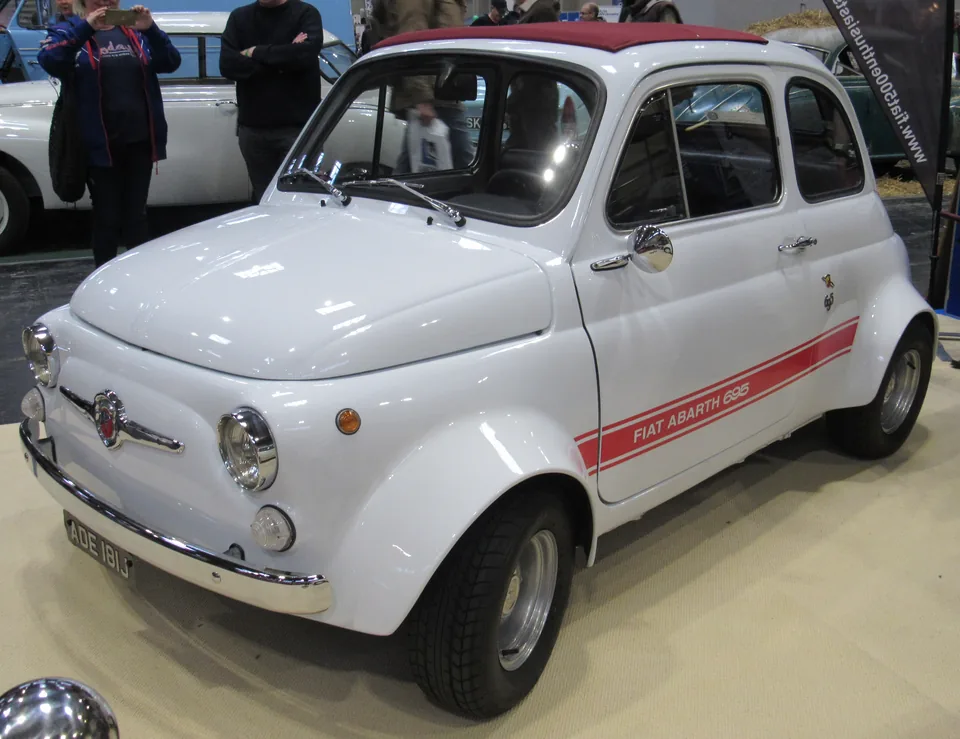
Fiat-Abarth 695 SS
Why 4.0: One more bore job took the twin from 594cc to 689.5cc and 38 hp, and Abarth built exactly 1,000 examples between 1964 and 1971 — enough to matter, rare enough to matter now. Auction results have held a stable $40,000-$48,000 band for several years, the mark of a market driven by owners rather than speculators.
Layout
Natural habitat
Ride comfort
Sound
The same air-cooled twin bored out and wound to 7,000 rpm, where the extra revs sharpen the 595's thrash into something closer to a bark. It is still 695cc of two-cylinder, which keeps it in the novelty half of this index.
2-cylinder · naturally aspirated · 7,000 rpm redline · rated 6.2 / 10 for engine sound
Market value
Median asking price, good condition · €1k (1964) → €41k (2026), trending up · illustrative data
Child seats · ISOFIX
Built before ISOFIX existed, so there are no anchor points at all. A child seat here is a seatbelt installation, and the belt geometry of the period was not designed with one in mind.
Derived from production years and seating layout, not a per-car source. ISOFIX was standardised as ISO 13216 in 1997, required on new EU model types from 2011 and on all new EU cars from 2014.
The long version
The 695 SS existed because racers kept asking Abarth for more, and 594cc turned out not to be a hard ceiling — one more overbore, to 689.5cc, plus a reworked head and a bigger carburetor pushed output to 38 hp, enough to make a 530-kg car feel genuinely quick by the standards of 1964. Abarth built exactly 1,000, most badged simply 'Fiat Abarth 695' with 'SS' script down the flank, and later Assetto Corsa Radiale versions pushed closer to 49 hp for buyers racing rather than just showing off at the local Sunday hillclimb. Unlike some of the more speculative corners of the classic-Fiat market, the 695 SS's recent auction results — a run of sales clustering between $40,000 and $48,000 across 2023 and 2024 — describe a market in equilibrium rather than one being chased upward: values that hold steady for years usually mean an established base of owners who already know what they have and aren't selling into a spike. It remains eligible for a wide range of historic touring-car and hillclimb events across Europe, and enough of the surviving 1,000 turn up at them that this isn't just a theoretical use case.