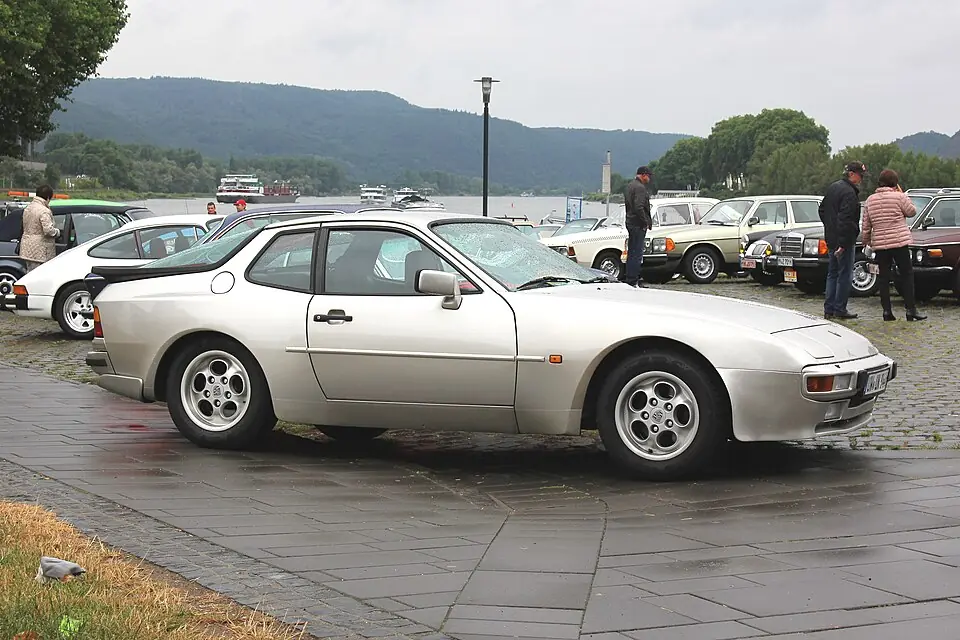
Porsche 944
Why 7.0: Transaxle balance and parts-bin prices kept it a driver's classic while everything air-cooled went to auction. Still the right answer to 'first track car'.
Layout
Natural habitat
Ride comfort
Sound
A 2.5-litre four with balance shafts, effectively half a 928 V8, giving a deep even thrum instead of the usual four-pot thrash. But those balance shafts smooth away most of the character and 6,500 rpm caps the climb. Pleasant and unremarkable; nobody bought a 944 for this.
4-cylinder · naturally aspirated · 6,500 rpm redline · rated 5.2 / 10 for engine sound
Market value
Median asking price, good condition · €7k (2000) → €26k (2026), trending up · illustrative data
Child seats · ISOFIX
Built before ISOFIX existed, so there are no anchor points at all. A child seat here is a seatbelt installation, and the belt geometry of the period was not designed with one in mind.
Derived from production years and seating layout, not a per-car source. ISOFIX was standardised as ISO 13216 in 1997, required on new EU model types from 2011 and on all new EU cars from 2014.
The long version
The 944 became the workaround for people priced out of an air-cooled 911 who still wanted a Porsche they could track without a second mortgage, and that buyer profile has driven the last decade's price climb more than any sudden collector interest. Parts sharing with the 924 and 968 keeps a transaxle car this old genuinely usable, which matters because most examples are still bought to be driven hard rather than polished. Prices have crept high enough that the 'affordable' part of the reputation is starting to need air quotes, but the ownership behavior hasn't caught up to the new math yet.