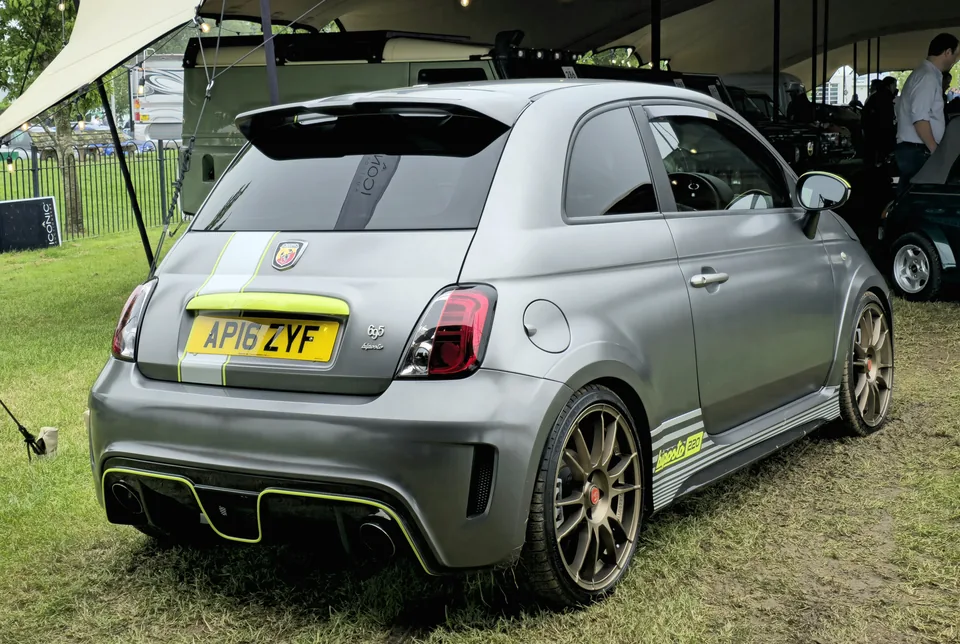
Abarth 695 Biposto
Why 7.5: 190 hp, 997 kg, no rear seats — just a roll bar where they used to be — and an optional €10,000 dog-ring racing gearbox that lets you shift flat-out without the clutch. Only 133 were built, none for the US, and a decade later they still trade close to their original price — proof this was bought to be driven, not banked.
Layout
Natural habitat
Ride comfort
Sound
The standard Akrapovic titanium system is harder and clearer than any Record Monza, and the optional dog-ring gearbox adds a straight-cut whine no other hot hatch offers. But the 1.4 T-Jet still runs out at 5,750 rpm with a turbo muffling the top.
4-cylinder · turbocharged · 5,750 rpm redline · rated 7.7 / 10 for engine sound
Market value
Median asking price, good condition · €55k (2014) → €45k (2026), trending down · illustrative data
Child seats · ISOFIX
There aren't any — strict two-seater.
The only position there is, so makers of this era equip it: expect a passenger-airbag cut-off (key switch or occupant sensing) as standard, because there is no rear row to point children to. Whether the seat itself carries ISOFIX anchors is maker-specific — Porsche bundles them with its child-seat preparation, Ferrari sold them as an option, others are belt-mount only with the airbag off.
Derived from production years and seating layout, not a per-car source. ISOFIX was standardised as ISO 13216 in 1997, required on new EU model types from 2011 and on all new EU cars from 2014.
The long version
Every other special edition on this shelf added a stripe and a badge to a Fiat 500; the Biposto took things out. Abarth deleted the rear seats entirely, replacing them with a roll bar most track organizers require anyway, fitted lightweight Sabelt Corsa racing buckets trimmed in leather and Alcantara, and dropped weight to a genuinely light 997 kg for a turbocharged hot hatch. The headline option was a proper motorsport dog-ring gearbox, developed with transmission specialist Bacci Romano, that lets a quick enough driver bang through the gears at full throttle without touching the clutch — a feature borrowed straight from racing cars, offered for a further €10,000 on top of the car's own steep £36,610 UK launch price, about $60,000 at the time for what was still fundamentally a modified city car. Reviewers found the pricing hard to justify next to a Golf GTI or a Focus ST with more space and less drama, and only 133 were built as a result, none allocated to the US market. A decade on, that skepticism shows up as a flat value curve rather than a collector spike — good examples still trade around €44,900, not far off the original sticker in real terms — which is exactly what you'd expect from a car bought by people who wanted the dog-ring gearbox to actually use it, not to park it.