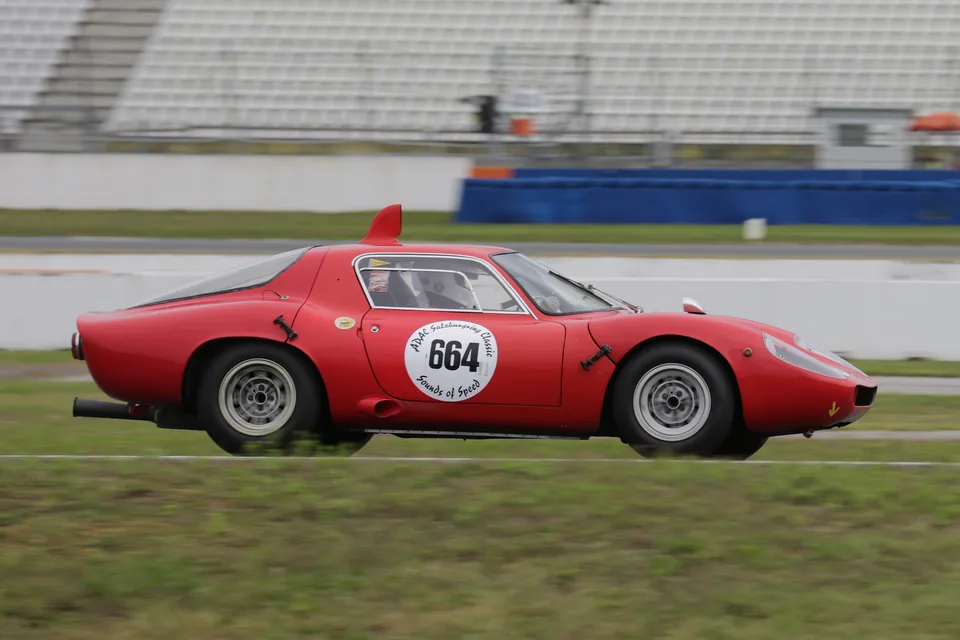
Abarth 1300 OT Periscopica
Why 2.5: Named for the periscope-shaped roof vent Abarth engineered after realizing the cockpit — with water and oil lines running straight through it — was too hot for endurance racing. Fiberglass body on a tube frame, dry-sump 1,289cc four making up to 157 hp, and only 50 Series I cars built to satisfy Group 4 homologation; it won the 1966 and 1967 Division 1 GT world championship outright.
Layout
Natural habitat
Ride comfort
Sound
The mid-mounted twin-cam sits directly behind an unlined cockpit, unsilenced and revving to 7,500 — the hardest noise Abarth built for the small classes. It is capped by 1.3 litres of four-cylinder, which gives it pitch and volume but no weight.
4-cylinder · naturally aspirated · 7,500 rpm redline · rated 7.6 / 10 for engine sound
Market value
Median asking price, good condition · €7k (1965) → €202k (2026), trending up · illustrative data
Child seats · ISOFIX
Built before ISOFIX existed, so there are no anchor points at all. A child seat here is a seatbelt installation in the only passenger seat there is.
Derived from production years and seating layout, not a per-car source. ISOFIX was standardised as ISO 13216 in 1997, required on new EU model types from 2011 and on all new EU cars from 2014.
The long version
By 1965 Abarth's deal with Simca was over and Chrysler had no interest in funding a competition program, so Carlo Abarth turned the same small-GT formula back onto Fiat mechanicals and built something purpose-designed for endurance racing from the ground up: a fiberglass body on a bespoke tube frame, a front-mounted, longitudinally sited 1,289cc four feeding a five-speed transaxle at the rear for better weight distribution, dry-sump lubrication, twin-plug ignition and disc brakes all round. The problem endurance racing exposed almost immediately was heat — with cooling lines routed straight through the cockpit, drivers were cooking alive on long stints — and Abarth's fix became the car's defining feature: an off-center, periscope-shaped intake scooped into the roof, channeling outside air directly onto the driver. The OT 1300 debuted as a prototype at the September 1965 Nürburgring 500km, and Abarth built 50 Series I examples through early 1966 to secure Group 4 homologation, upgrading to a wider-tracked Series II with a bulbous plexiglass rear window later in the run. The car won its class outright at the Targa Florio and elsewhere, and took the Division 1 GT World Championship in both 1966 and 1967 plus three straight Italian Group 4 titles — a serious return on 50-odd cars. A parallel OT 2000 shared the same body over a 1,946cc four making around 208 hp, but only a handful were built. Almost nothing about the OT 1300 was designed for road use, and the survivors mostly still live the life they were built for: historic GT grids and the occasional concours appearance, not road rallies.