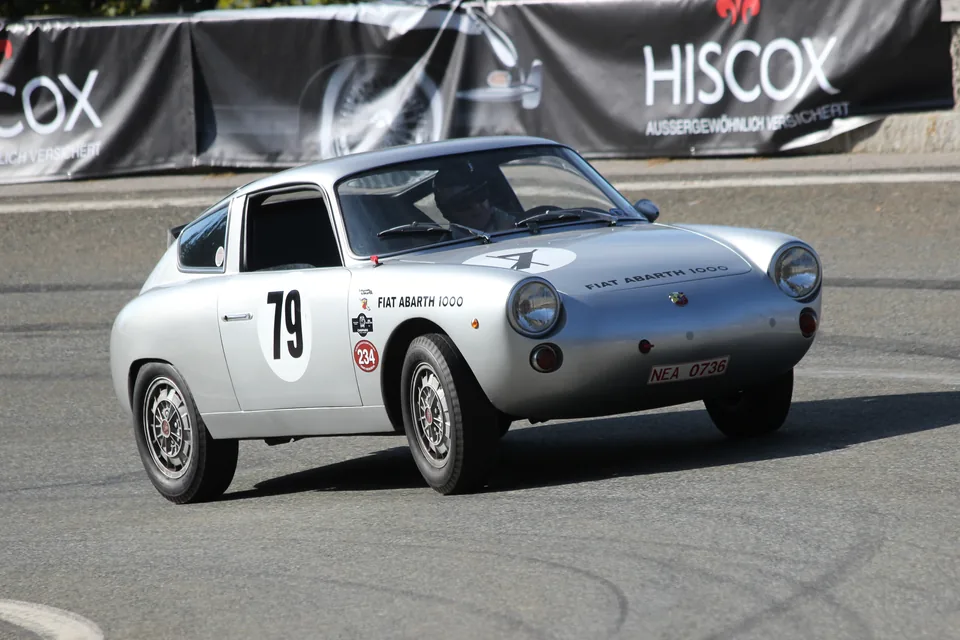
Fiat-Abarth 1000 Bialbero
Why 2.7: A twin-cam alloy head on the 982cc Fiat 600 four, four-wheel discs, and a five-speed transaxle in a 560 kg aluminum Zagato-style body — Abarth's most sophisticated small-bore GT of the era. Bruce McLaren drove one to an under-1-liter class win at the 1961 Sebring 3 Hours; a documented example with that exact provenance sold for $337,000 in 2016.
Layout
Natural habitat
Ride comfort
Sound
A twin-cam one-litre in a stripped 600 shell, unsilenced and revving past 7,000, which is how it embarrassed larger cars on noise as well as pace. But a litre is a litre: the pitch is high and hard with nothing underneath it.
4-cylinder · naturally aspirated · 7,000 rpm redline · rated 7.3 / 10 for engine sound
Market value
Median asking price, good condition · €4k (1961) → €193k (2026), trending up · illustrative data
Child seats · ISOFIX
Built before ISOFIX existed, so there are no anchor points at all. A child seat here is a seatbelt installation in the only passenger seat there is.
Derived from production years and seating layout, not a per-car source. ISOFIX was standardised as ISO 13216 in 1997, required on new EU model types from 2011 and on all new EU cars from 2014.
The long version
Abarth's 750 and 850 cars had already proven the small-bore-Fiat-racer formula; the 1000 Bialbero, introduced at the 1961 Turin show, was the version built to actually win outright rather than just punch above its weight. The 982cc four got a genuine twin-cam (Bialbero) alloy head with hemispherical combustion chambers, twin Weber 40 DCOEs and Bosch ignition for 95 hp at 7,000 rpm — modest by today's standards, remarkable from under a liter in 1961 — paired with a five-speed transaxle and four-wheel disc brakes at a time when drums were still common even on serious sports cars. The body, hand-formed aluminum in the Zagato style over a tube frame, weighed the whole car in at just 560 kg, and period road tests clocked 0-60 in 7.4 seconds and a 131 mph top speed — staggering numbers for the class. Briggs Cunningham's American team entered one at the 1961 Sebring 3 Hours with Bruce McLaren driving, and it won the under-1,000cc GT class outright; Abarth backed that up with the European GT championship for the same class in 1962 and 1963. That competition pedigree now drives the market hard: a documented, McLaren-connected example sold for $337,000 in 2016, though most surviving cars without that exact provenance trade well below it. Either way, these are museum and concours pieces now, wheeled out for the occasional hillclimb demonstration run rather than driven the way Cunningham's team used them.