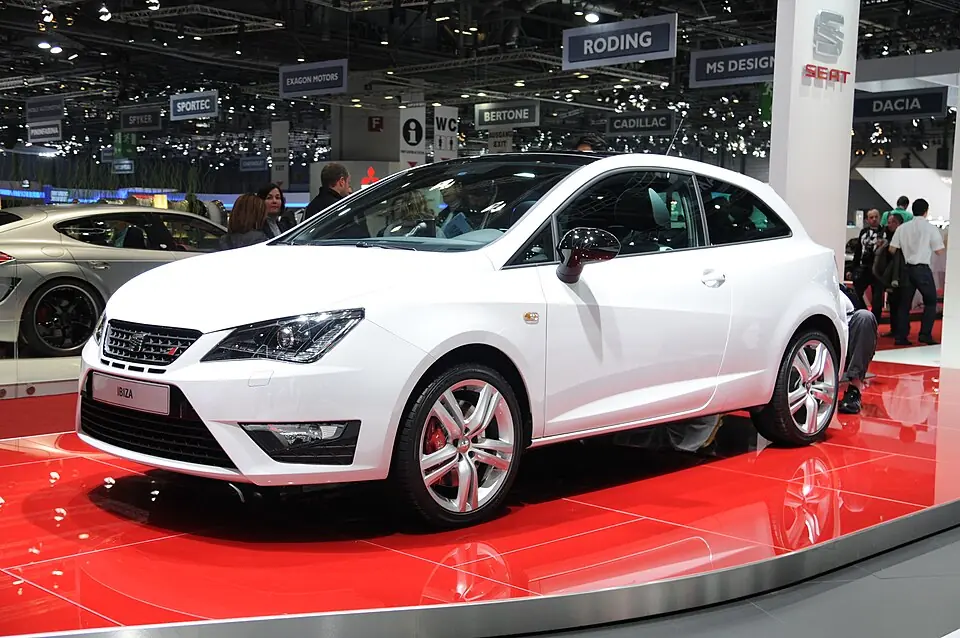
SEAT Ibiza Cupra
Why 8.2: SEAT never sold a single car in America, so this GTI-fighter is invisible to US enthusiasts despite sharing its turbo four with cars that did cross the Atlantic. In Europe it is a genuinely unpretentious used buy — nobody cross-shops a SEAT for the badge.
Layout
Natural habitat
Ride comfort
Sound
The 1.8 TSI has some induction growl and the ECU throws in a little overrun crackle. But it is a VW Group four with a standard exhaust and a synthesised layer inside, and nothing about it is identifiable by ear. Anonymous in a way the Abarths never are.
4-cylinder · turbocharged · 6,500 rpm redline · rated 4.2 / 10 for engine sound
Market value
Median asking price, good condition · €21k (2017) → €12k (2026), trending down · illustrative data
Child seats · ISOFIX
Rear outboard seats get ISOFIX and top-tether as standard.
Despite sharing its MQB-A0 platform with the Polo, the Ibiza's front passenger seat carries no ISOFIX anchor — Euro NCAP marks it 'not available', not even as an option.
A genuine platform-mate gap: same MQB-A0 underpinnings as the Polo, but no front ISOFIX where the Polo offers it standard.
Euro NCAP SEAT Ibiza (2017)
The long version
SEAT has never sold a car in the United States, full stop, which makes the Ibiza Cupra invisible to American enthusiasts despite running the same turbocharged EA888-family four found under cars that did cross the Atlantic. In Europe it occupies an odd niche: genuinely quick, cheaper than an equivalent Volkswagen Polo GTI, and permanently overshadowed by SEAT's own decision to spin performance off into the standalone Cupra brand just a couple of years after this generation ended. Nobody buys one for the badge — there is no badge equity to buy into — which leaves an ownership base that wanted a fast, unpretentious hatchback and found the cheapest way into one. It depreciated hard and stayed there, a mainstream-European-hatchback curve with no speculative interruption anywhere on the chart.