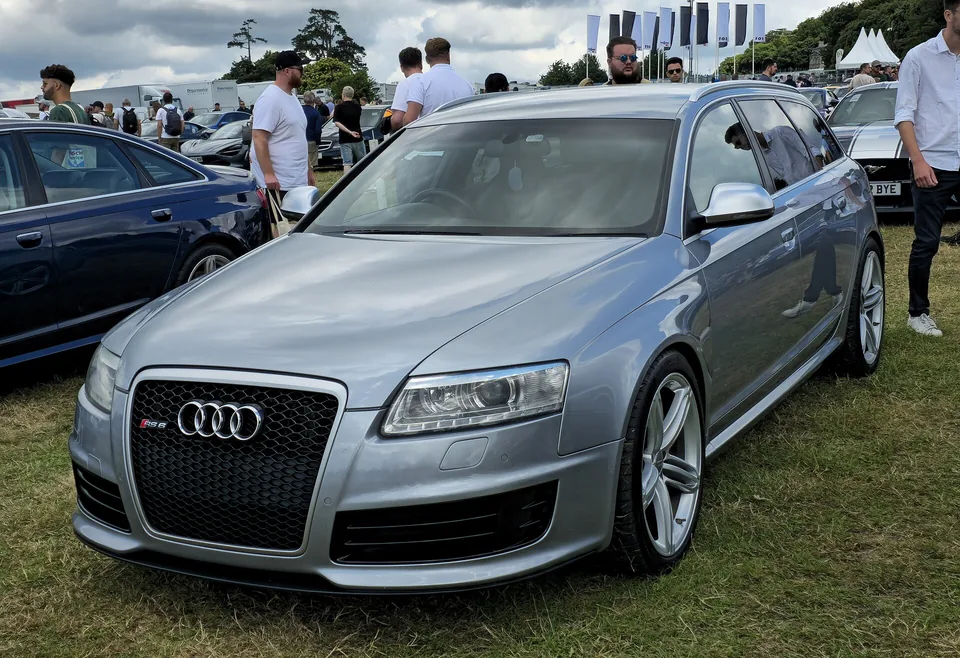
Audi RS6 Avant (C6)
Why 6.7: Audi put two turbochargers on a 5.0-litre relative of the Gallardo's V10, made 580 PS, and sold it as an estate car in Europe only. Every other RS6 has been a V8 — that engine is the whole argument for this one, and its running costs are the whole argument against.
Layout
Natural habitat
Ride comfort
Sound
Ten cylinders in an estate car, sharing their architecture with the Gallardo's, and at part throttle there is a genuine V10 hum no V8 RS6 has ever produced. But two turbochargers sit between that and the tailpipes and Audi insulated the C6 for autobahn quiet, so the exotic top end never arrives. Still the best-sounding RS6.
10-cylinder · turbocharged · 7,000 rpm redline · rated 6.9 / 10 for engine sound
Market value
Median asking price, good condition · €100k (2008) → €42k (2026), trending down · illustrative data
Child seats · ISOFIX
Two ISOFIX positions on the outer rear seats, the outer pair being the ones the standard covers.
The rear anchors are the supported route — the manual points child seats there, and front-passenger ISOFIX is the exception rather than the rule. A belt-mounted seat up front needs the airbag off, and cars with a rear row don't always fit a deactivation switch, precisely because the rear seats exist.
Derived from production years and seating layout, not a per-car source. ISOFIX was standardised as ISO 13216 in 1997, required on new EU model types from 2011 and on all new EU cars from 2014.
The long version
The C6 RS6 exists because Audi had a V10 and a reason to use it. The 4,991 cc unit shares its architecture with the naturally aspirated ten in the R8 and the Lamborghini Gallardo, but around 400 components are unique to it, chiefly because two turbochargers and their plumbing had to fit inside a V6-sized engine bay. The result made 580 PS between 6,250 and 6,700 rpm and 650 Nm from 1,500 rpm, and was for a time the most powerful road car Audi had built. It also weighed 2,025 kg, came only with a six-speed ZF automatic, and was never sold in North America — the United States went from the C5 straight to the C8, skipping both the V10 and the V8 C7. What has happened since is a study in how running costs shape an ownership pattern. Dynamic Ride Control, the diagonally cross-linked hydraulic damper system, leaks and is expensive to replace. The V10 is a direct-injection engine of its era, so carbon build-up is routine work, and there are ten cylinders' worth of it. Values fell to roughly a quarter of list, which drew in owners who could afford the purchase and not the maintenance, and a meaningful number of these went off the road as a result. The survivors are held by people who knew the numbers going in and budget accordingly, and prices have started to climb again for exactly one reason: nothing else Audi sells will ever have ten cylinders in it.