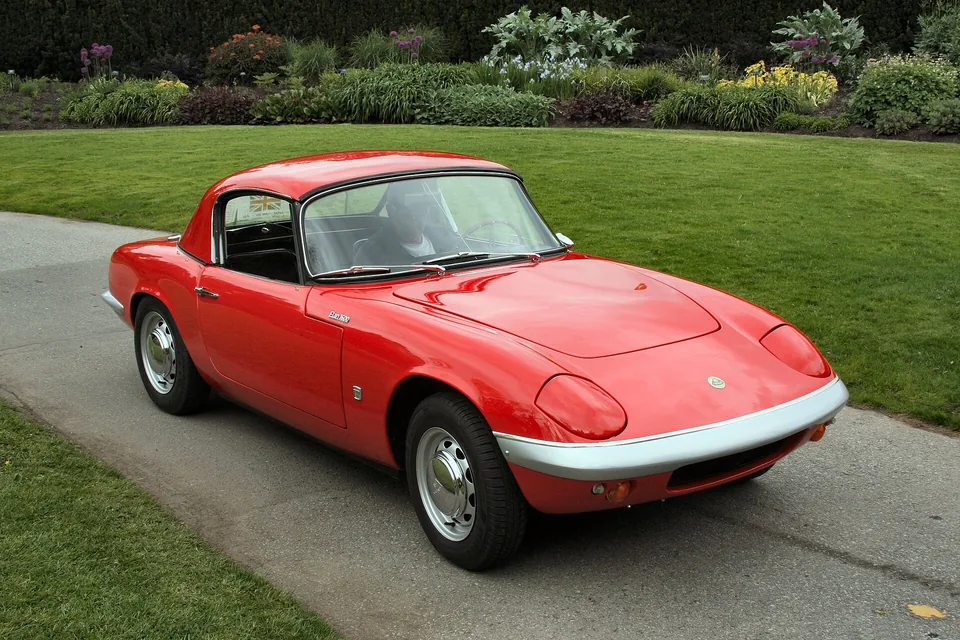
Lotus Elan S1
Why 5.4: Colin Chapman's first commercially successful road car, and the one every lightweight sports car since has been measured against — the Mazda MX-5's engineers said so out loud. Roughly 900 S1s were built, which is why the survivors are cherished rather than commuted in.
Layout
Natural habitat
Ride comfort
Sound
Twin Weber 40s on a Lotus-Ford twin-cam with almost nothing between the engine bay and the pedals, so the induction rasp arrives unfiltered and hardens past 4,500 rpm. But it is a 1.6 four on a mild exhaust running out at 6,500 rpm. The noise the MX-5 was later accused of imitating, and better than the Mazda ever managed.
4-cylinder · naturally aspirated · 6,500 rpm redline · rated 6.8 / 10 for engine sound
Market value
Median asking price, good condition · €4k (1962) → €51k (2026), trending up · illustrative data
Child seats · ISOFIX
Built before ISOFIX existed, so there are no anchor points at all. A child seat here is a seatbelt installation in the only passenger seat there is.
Derived from production years and seating layout, not a per-car source. ISOFIX was standardised as ISO 13216 in 1997, required on new EU model types from 2011 and on all new EU cars from 2014.
The long version
The Elan is the car that kept Lotus solvent. The Elite before it was a structural-glassfibre monocoque that was brilliant, expensive and lost money on every example; the Elan replaced it with a folded sheet-steel backbone chassis weighing 34 kg, with a glassfibre body bolted to it at sixteen points, and the whole car came in around 660 kg. On top of that went a Lotus-designed twin-cam head on a Ford Kent block — 1,498 cc at launch in October 1962, enlarged to 1,558 cc within months — making 105 bhp, plus four-wheel independent suspension, four-wheel disc brakes and rack-and-pinion steering, a specification no small British sports car of 1962 came close to. What it produced was a chassis that has been the reference ever since. Gordon Murray has said the Elan informed the McLaren F1's steering; Mazda's team benchmarked one directly while developing the MX-5. What it also produced was a car that rusts its chassis, cracks its bodyshell around the mounting points and demands constant attention to the doughnut couplings in the driveshafts, which is why so few of the roughly 900 S1s survive in original form. Those that do are worth around fifteen times what the S2 and S3 cars were worth twenty years ago, and are used the way valuable, fragile, dry-weather cars get used: club runs, tours, the occasional sprint, and a tarpaulin the rest of the year. The score reflects that, not the driving, which remains as good as everybody says.