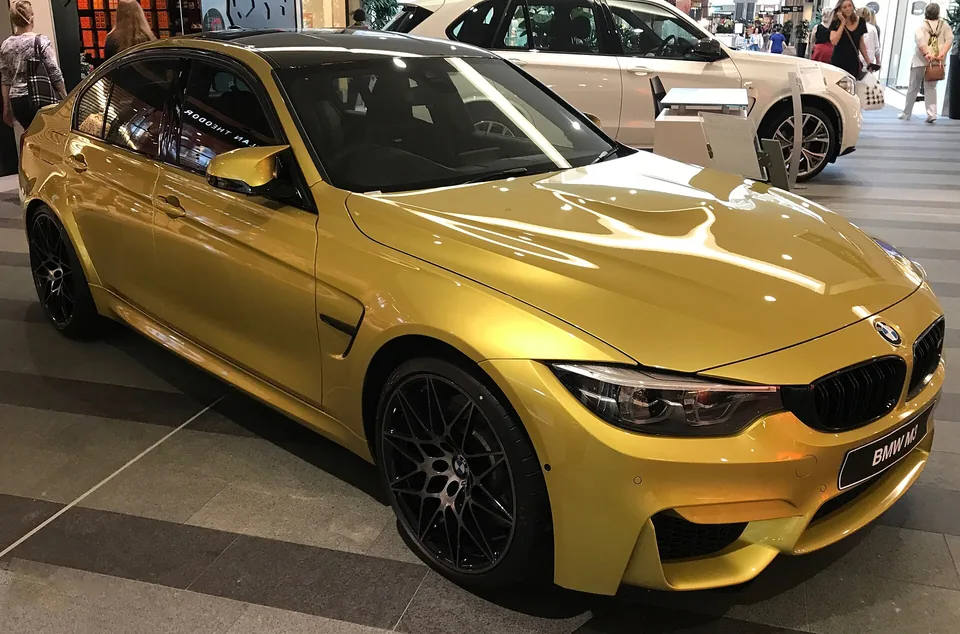
BMW M3 (F80)
Why 7.8: The first turbocharged M3, and the generation that took the loudest criticism for it. It is also the cheapest way into a modern M3, which is why these are bought used by people who intend to use them — tuned, tracked, commuted in, and rarely parked as investments.
Layout
Natural habitat
Ride comfort
Sound
The S55 barks hard under load and still pulls to 7,600 rpm, 400 beyond the S58 that replaced it. But BMW routed the character through Active Sound Design in the cabin speakers because the real exhaust note came out thin, and you can hear the seam. Above the piped i8, below the M2 Competition on the same engine.
6-cylinder · turbocharged · 7,600 rpm redline · rated 5.4 / 10 for engine sound
Market value
Median asking price, good condition · €57k (2015) → €40k (2026), trending down · illustrative data
Child seats · ISOFIX
Two ISOFIX positions on the outer rear seats, the outer pair being the ones the standard covers.
The rear anchors are the supported route — the manual points child seats there, and front-passenger ISOFIX is the exception rather than the rule. A belt-mounted seat up front needs the airbag off, and cars with a rear row don't always fit a deactivation switch, precisely because the rear seats exist.
Derived from production years and seating layout, not a per-car source. ISOFIX was standardised as ISO 13216 in 1997, required on new EU model types from 2011 and on all new EU cars from 2014.
The long version
The F80 arrived in 2014 carrying two changes at once: the S65 V8 was gone, replaced by the twin-turbo S55 straight-six, and the M3 name went saloon-only while the coupe became the M4. The engineering underneath is more serious than the reception suggested — a carbon-fibre roof, a carbon propshaft, forged aluminium suspension links and around 80 kg saved over the E92 — and the S55 makes 431 PS with 550 Nm from 1,850 rpm, which is a completely different way of covering ground from the V8 it replaced. What the enthusiast press could not forgive was the noise. The real exhaust note went thin, BMW compensated with Active Sound Design piped through the cabin speakers, and the argument about that ran for the entire production span and beyond. It has had one clear effect on ownership: nobody hoards an F80. Values fell steadily to a floor around the early 2020s, at which point the car became the obvious used performance-saloon buy — four doors, a warranty-era chassis, a genuine manual option in most markets, and a tuning industry that will find another hundred horsepower for the price of a service. These get driven hard and often. Manual cars have since firmed up as the enthusiast choice and the F80 CS has drifted into collector territory, but the mass of the generation is doing exactly what an M3 was always supposed to do.