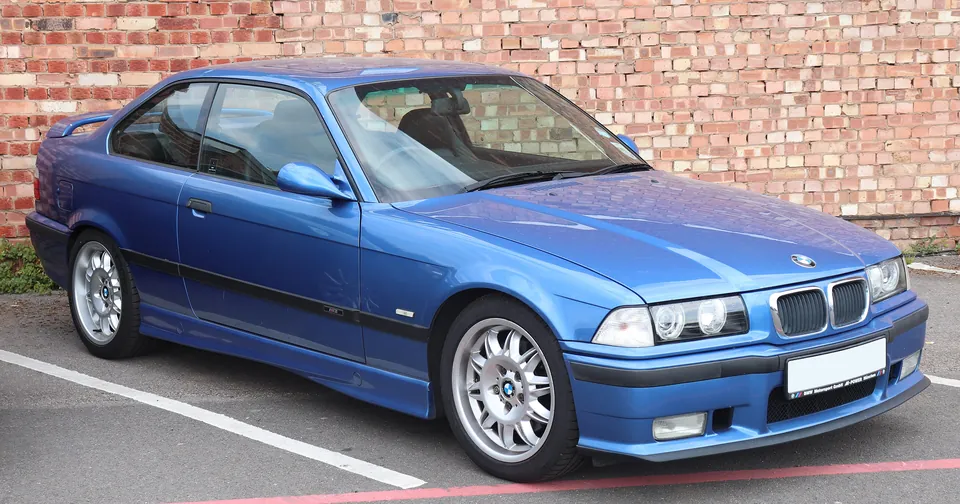
BMW M3 (E36)
Why 7.0: BMW replaced the E30's homologation four with a straight six, added a saloon and a convertible, and built 71,242 cars — five times the first M3's run. North America got a different, cheaper engine rated 240 hp against Europe's 316, a split BMW has never repeated quite this bluntly.
Layout
Natural habitat
Ride comfort
Sound
The S50 straight-six is creamy where the later S54 is metallic, and the European 3.2 pulling to 7,600 rpm still makes a fine hard six-cylinder noise. American cars got the S52, essentially a 328 engine, which is why this sits a step below the E46.
6-cylinder · naturally aspirated · 7,600 rpm redline · rated 7.6 / 10 for engine sound
Market value
Median asking price, good condition · €33k (1995) → €39k (2026), trending up · illustrative data
Child seats · ISOFIX
ISOFIX was spreading through these years rather than fitted across the board — whether a given car has rear anchors depends on its year and market.
Children were expected in the back. Front-passenger ISOFIX effectively didn't exist in this era, and airbag deactivation was patchy — treat the front seat as a no unless a specific car proves otherwise.
Derived from production years and seating layout, not a per-car source. ISOFIX was standardised as ISO 13216 in 1997, required on new EU model types from 2011 and on all new EU cars from 2014.
The long version
The E30 M3 existed because Group A demanded five thousand road cars. The E36 existed because BMW had worked out that people would buy an M3 whether or not a rulebook required one, so the second generation arrived as a range rather than a homologation run: coupé from 1992, saloon and convertible soon after, 71,242 cars all told. Europe got the S50 — 286 PS from three litres, then 321 PS from 3.2 after the 1995 facelift, with a six-speed gearbox and the first SMG automated manual BMW ever sold. North America got the S50B30US and later the S52, both rated 240 hp, because BMW judged the full-strength car could not be priced against a Corvette. Owners have been arguing about that decision for thirty years and Euro-engine swaps are a small industry. Values bottomed around 2012 at hot-hatch money, which is precisely when a great many were caged, coilovered and turned into race cars — Spec E36 is a national class in the United States. Clean original examples have since become expensive. The rest are still out being used, which is rather the point.