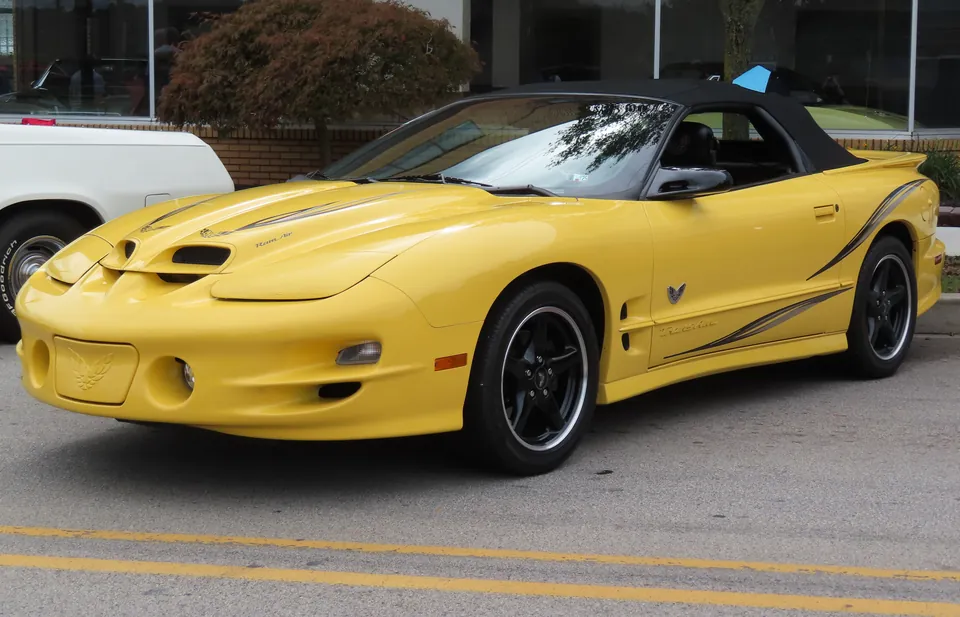
Pontiac Firebird Trans Am WS6
Why 7.3: WS6 bought a functional ram-air bonnet, stiffer suspension and wider wheels on top of the C5 Corvette's LS1, for roughly half of what a Corvette cost. It kept a live rear axle to the very end, which is most of why it was cheap and all of why it drives like a hot rod rather than a sports car.
Layout
Natural habitat
Ride comfort
Sound
The WS6's twin bonnet nostrils are functional, and the induction moan they let in over the LS1's deep burble is the best part of the car's noise. It is capped by a restrained factory exhaust and 6,000 rpm, so it rumbles convincingly without ever rising.
8-cylinder · naturally aspirated · 6,000 rpm redline · rated 6.8 / 10 for engine sound
Market value
Median asking price, good condition · €28k (2000) → €35k (2026), trending up · illustrative data
Child seats · ISOFIX
ISOFIX was spreading through these years rather than fitted across the board — whether a given car has rear anchors depends on its year and market.
Children were expected in the back. Front-passenger ISOFIX effectively didn't exist in this era, and airbag deactivation was patchy — treat the front seat as a no unless a specific car proves otherwise.
Derived from production years and seating layout, not a per-car source. ISOFIX was standardised as ISO 13216 in 1997, required on new EU model types from 2011 and on all new EU cars from 2014.
The long version
The fourth-generation Firebird received the LS1 for 1998, which is the point at which the Trans Am became genuinely fast: 320 hp from the same aluminium 5.7-litre V8 fitted to the C5 Corvette, rising to 325 hp for 2001, in a car costing about half as much. WS6 was the option code for the Ram Air Performance and Handling Package — a bonnet with two functional nostrils feeding the airbox, firmer springs and dampers, thicker anti-roll bars, 17-inch wheels — and it is the specification everybody now wants. Underneath sat a live rear axle, which explains both the price and the character: enormous straight-line ability, tidy enough on a smooth road, thoroughly unsettled by a bumpy one. General Motors closed the Sainte-Thérèse plant and killed the Firebird and Camaro together after 2002, and the run ended with the Collector Edition — Collector Yellow, WS6 standard, just under two thousand built. Values collapsed for a decade and have climbed since, but from a base low enough that these are still bought as fast cars rather than as investments.