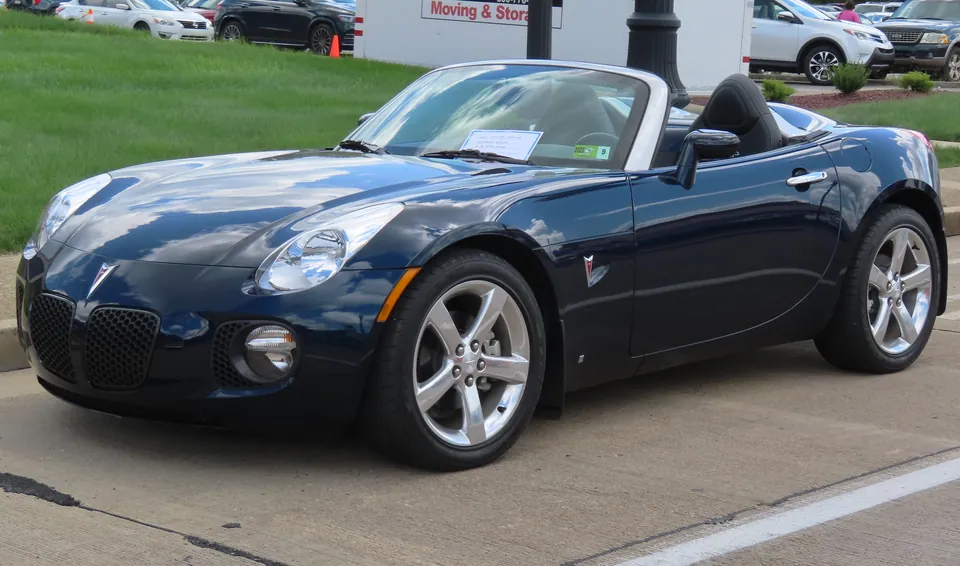
Pontiac Solstice GXP
Why 7.3: GM's Kappa roadster finally got the engine the styling had been promising — the same 260 hp direct-injection turbo that made the Cobalt SS quick, driving the rear wheels this time. Then Pontiac was shut down, leaving a two-seater with no successor, no speculative interest, and a boot you cannot use with the roof down.
Layout
Natural habitat
Ride comfort
Sound
The same LNF turbo four, but roadster bodywork means the induction whoosh and the wastegate reach you unfiltered with the roof down. The engine is still a clattery direct-injection GM four with a 6,300 rpm ceiling, so the openness is doing the work.
4-cylinder · turbocharged · 6,300 rpm redline · rated 4.5 / 10 for engine sound
Market value
Median asking price, good condition · €24k (2008) → €23k (2026), trending down · illustrative data
Child seats · ISOFIX
There aren't any — strict two-seater.
The only position there is, so makers of this era equip it: expect a passenger-airbag cut-off (key switch or occupant sensing) as standard, because there is no rear row to point children to. Whether the seat itself carries ISOFIX anchors is maker-specific — Porsche bundles them with its child-seat preparation, Ferrari sold them as an option, others are belt-mount only with the airbag off.
Derived from production years and seating layout, not a per-car source. ISOFIX was standardised as ISO 13216 in 1997, required on new EU model types from 2011 and on all new EU cars from 2014.
The long version
The Solstice arrived in 2006 looking far faster than its 177 hp naturally aspirated four could support. The GXP fixed that with the 2.0-litre direct-injection LNF turbo out of the Cobalt SS — 260 hp and 260 lb-ft, with an overboost function taking peak torque higher still — driving the rear wheels through a five-speed manual on a chassis with close to even weight distribution. It was quick and it handled, and it was also compromised in ways that were never resolved: the roof is a manual fold-out procedure, and with it stowed the boot holds essentially nothing. A hardtop coupe arrived for 2009 and then General Motors announced the end of Pontiac, so barely more than a thousand coupes were built before the line stopped. That is the whole arc — three model years, no successor, and a car that has never been expensive. What survives belongs to people who specifically wanted this oddity instead of a Miata, and they use it, because fifteen years of flat values have never given anyone a reason not to.