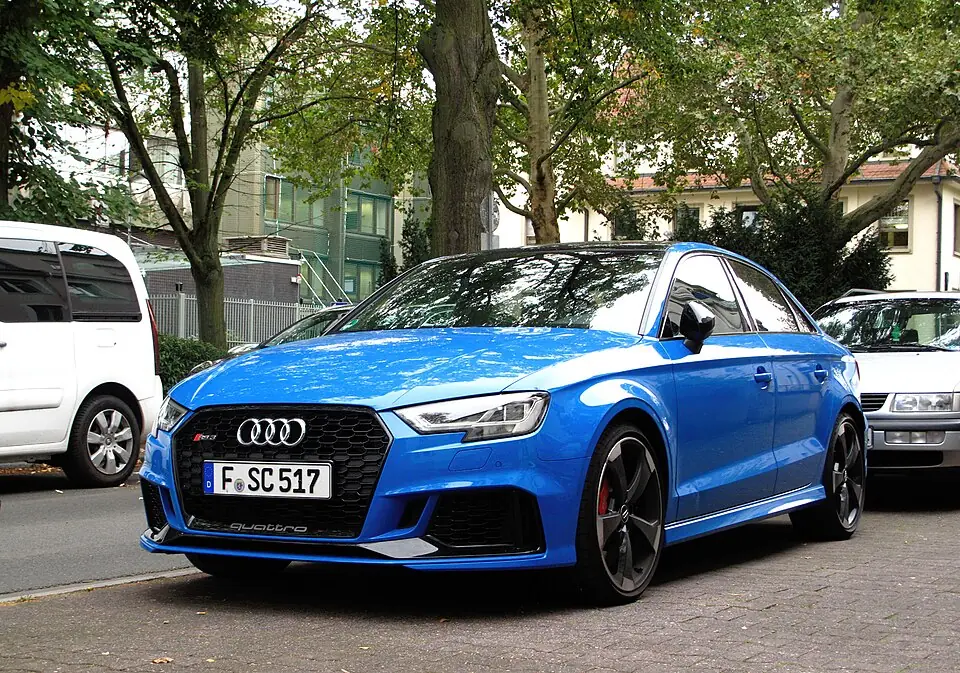
Audi RS 3
Why 7.4: Same warbling five-cylinder and quattro AWD as the TT RS, in a body buyers can actually live with daily — back seats, a trunk, none of the coupe's compromises. Nobody cross-shops this against a manual car; the S tronic and all-wheel drive are the entire point, and the ownership pattern shows it: driven in weather that would sideline a rear-drive alternative.
Layout
Natural habitat
Ride comfort
Sound
The 1-2-4-5-3 firing order gives the 2.5 five its off-beat warble, the one noise in this class nobody else can copy. But it is turbocharged, well muffled and topped up through the speakers, so the character survives while the intensity does not.
5-cylinder · turbocharged · 7,000 rpm redline · rated 7.0 / 10 for engine sound
Market value
Median asking price, good condition · €51k (2018) → €31k (2026), trending down · illustrative data
Child seats · ISOFIX
Rear outboard ISOFIX and top-tether anchors are standard.
Front ISOFIX is a cost option on the A3 platform this RS3 shares, per Euro NCAP's table — not standard, but genuinely available, unlike SEAT's version of the same platform.
Euro NCAP Audi A3
The long version
Audi sat on the idea of a US-market RS3 sedan for years while Europe got the Sportback, and when it finally arrived it inherited the TT RS's turbocharged inline-five almost unchanged — same off-beat exhaust note, same quattro all-wheel drive, now wrapped in a shell with real back seats and a trunk instead of a hatch. That practicality is the whole sales pitch: buyers who wanted an M2 or a Civic Type R but needed to also carry car seats found this instead, and the ownership data reflects a car that gets commuted and toured far more than it gets trailered to a track. Depreciation has followed the ordinary path for a low-volume German performance sedan — steep early, flattening out once the badge-chasers moved on to whatever Audi announced next. What's left is a genuine sleeper that does everything a Golf R does with one more cylinder and a nicer interior.