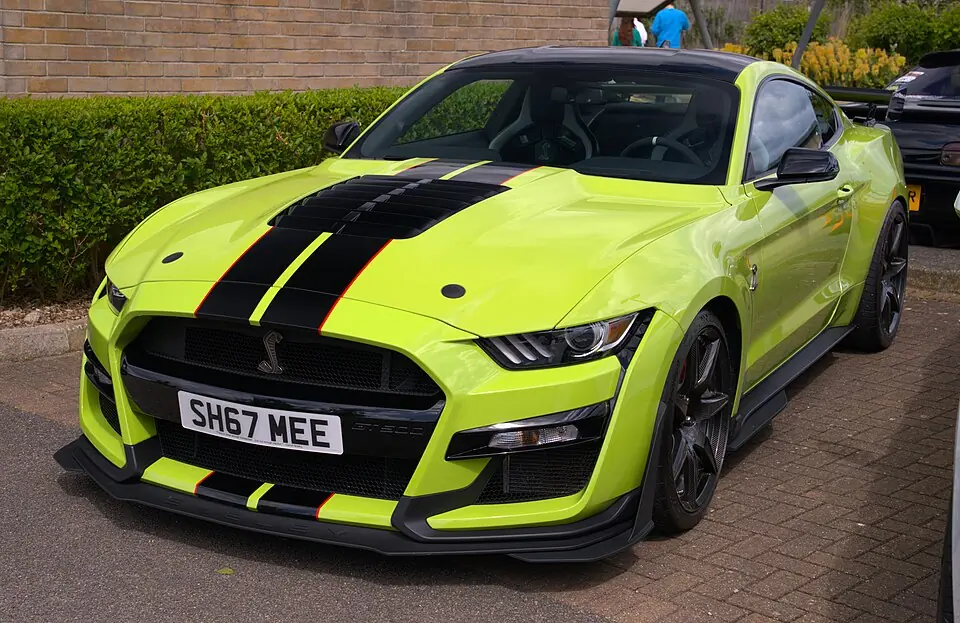
Ford Mustang Shelby GT500
Why 5.5: Ford dropped the manual entirely for the fastest street Mustang ever built, betting a 7-speed dual-clutch would put down 760 hp better than any driver could — and it does, at the cost of the one thing Shelby buyers used to demand. Launch-year markups pulled in flippers chasing a scarce VIN; the used market since has sorted itself back toward people who actually track the thing.
Layout
Natural habitat
Ride comfort
Sound
The Predator is cross-plane, so the base note is deep American V8 rumble with 2.65 litres of Eaton whining over it and an active exhaust to 7,500 rpm. But the blower is the star and it never finds the flat-plane howl the GT350 had. Theatre rather than tone.
8-cylinder · supercharged · 7,500 rpm redline · rated 7.6 / 10 for engine sound
Market value
Median asking price, good condition · €87k (2020) → €81k (2026), trending down · illustrative data
Child seats · ISOFIX
There aren't any — strict two-seater.
Same Ford front passenger sensing system as any S550 Mustang — belt the restraint in and the seat-mounted weight sensor is designed to disable the airbag automatically.
Rear-seat delete isn't standard on GT500 — it only comes with the optional $18.5k Carbon Fiber Track Package; a base GT500 keeps its 2+2 rear seat, which would flip this to a normal LATCH-equipped rear.
Ford Mustang Owner's Manual (Front Passenger Sensing System)
The long version
Ford built the GT500 as a drag-strip and road-course weapon first, wrapping the supercharged Predator V8 in a chassis with real aero, optional carbon-ceramic Brembos, and adaptive MagneRide dampers — then decided no clutch pedal would survive 625 lb-ft, a seven-speed dual-clutch only. That call cost it some of the purist crowd who wanted a third pedal on principle, but it also meant nobody buying one was signing up to row their own gears at a stoplight; the ownership pattern skews toward people who wanted the number on the spec sheet and the means to use it. Dealer markups at launch pulled in a flipper wave chasing scarce early-build VINs, the same pattern every hyped Mustang variant sees in its first year, and production ending in 2022 has since put a floor under that speculative premium. What's left driving it hardest are the track-day regulars who bought past the hype window specifically for the aero and the brakes, not the badge.