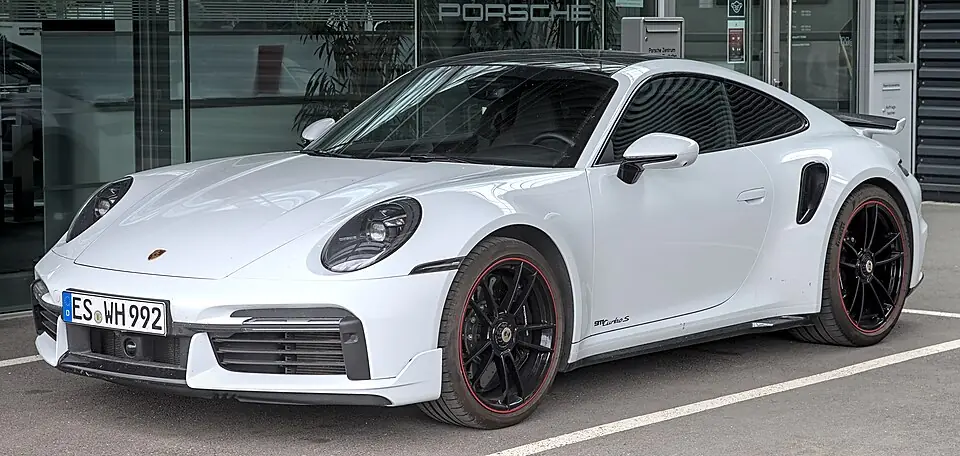
Porsche 911 Turbo S (992)
Why 7.3: Six-forty turbocharged horsepower delivered through PDK and all-wheel drive so completely that the car disappears into whatever the driver asks of it, commute or 2.6-second launch. That competence is exactly why the involvement number sits below the wing-equipped GT cars it outruns in a straight line.
Layout
Natural habitat
Ride comfort
Sound
Underneath is a flat-six, so a trace of the offbeat Porsche hum survives, and the sports exhaust lets some of it through. Two large turbochargers and a cabin built for daily use smother the rest — this is the quietest way Porsche sells a 911.
6-cylinder · turbocharged · 7,500 rpm redline · rated 6.2 / 10 for engine sound
Market value
Median asking price, good condition · €199k (2021) → €193k (2026), trending down · illustrative data
Child seats · ISOFIX
Two ISOFIX anchors on the rear seats, standard — and unlike the Carrera line, Turbo kept its rear seats standard even after the 992.2 facelift turned them into a delete-option elsewhere in the range.
Standard sport seats take the front-passenger ISOFIX-plus-airbag-switch option without any bucket-seat conflict.
Porsche 992 technical data; Motor1 coverage of the 992.2 rear-seat-as-option change
The long version
This is the 911 bought by people who want supercar pace without supercar compromise: PDK instead of a clutch pedal, all-wheel drive instead of a prayer in the wet, and a cabin comfortable enough for a daily commute. Owners actually use that everyday-weapon case, and mileage on these tends to run higher than the wing-equipped GT cars parked next to them at the dealership, because nothing about driving one demands a special occasion. The trade is legible in the numbers too: huge outright pace, but PDK-only and all-wheel drive filter out exactly the feedback a GT3 buyer is paying for.