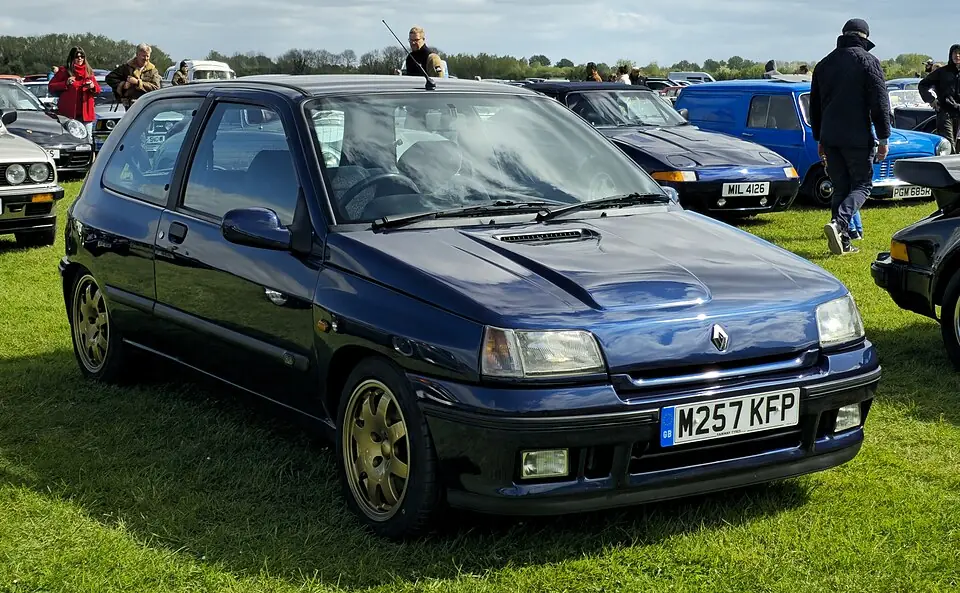
Renault Clio Williams
Why 5.3: Renault built it to homologate the Clio for Group A rallying and originally planned exactly 3,800 — the number the rulebook required, no more. Demand blew past that ceiling twice, into a Williams 2 and Williams 3 run, before the car went out of production.
Layout
Natural habitat
Ride comfort
Sound
The 2.0 F7R has a hard-edged rasp and pulls willingly to 7,200 rpm, which is more character than most early-1990s hatches managed. But it runs a standard silencer on a small four, so you get induction growl rather than a note that builds.
4-cylinder · naturally aspirated · 7,200 rpm redline · rated 6.1 / 10 for engine sound
Market value
Median asking price, good condition · €18k (1993) → €39k (2026), trending up · illustrative data
Child seats · ISOFIX
Built before ISOFIX existed, so there are no anchor points at all. A child seat here is a seatbelt installation, and the belt geometry of the period was not designed with one in mind.
Derived from production years and seating layout, not a per-car source. ISOFIX was standardised as ISO 13216 in 1997, required on new EU model types from 2011 and on all new EU cars from 2014.
The long version
Renault named it for its Formula 1 engine partner and originally capped production at 3,800 units, the bare minimum the Group A homologation rules required, finished exclusively in a specific blue with gold wheels that became the car's signature. Demand outran that number almost immediately, and Renault built two further Williams series to meet it, extending a car that was only ever supposed to exist to satisfy a rulebook. It spent years as a cheap enthusiast's classic before values started climbing hard in the last decade, pulling clean survivors out of daily use and into the same collector gravity that caught the 205 GTI before it.