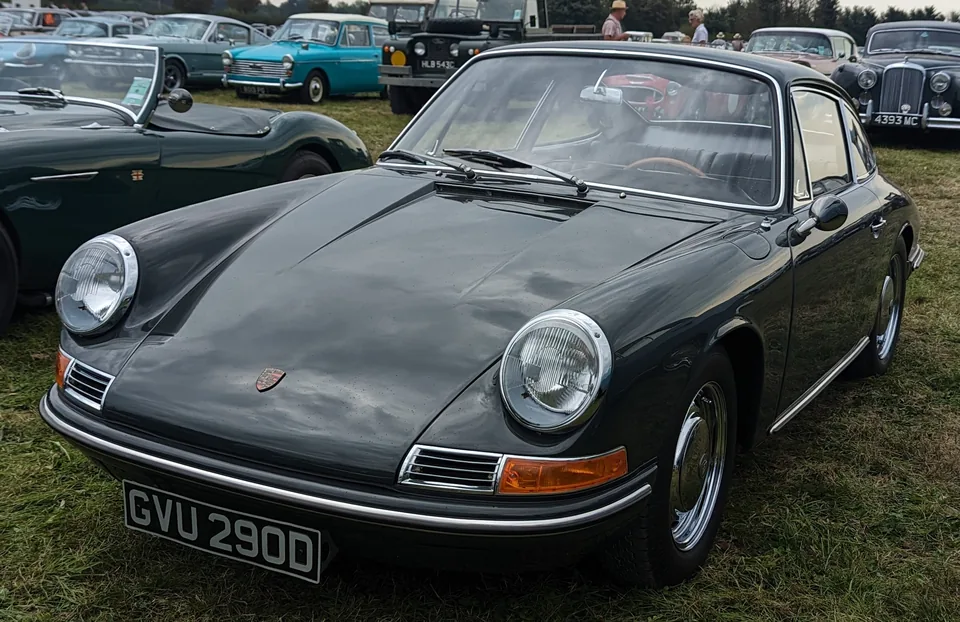
Porsche 911 2.0 (901)
Why 5.0: The car Porsche showed as the 901 in 1963 and renamed when Peugeot objected: a 2.0-litre air-cooled flat-six hung behind the rear axle, 130 hp, a dog-leg five-speed and 1,080 kg on steel wheels. Everything the badge has meant for sixty years — the shape, the engine position, the way it steers — was set here, in the short-wheelbase car built until 1967.
Layout
Natural habitat
Ride comfort
Sound
Two litres on six Weber chokes, a crank-driven fan and thin early insulation, so the first 911 has the whole air-cooled vocabulary — fan whir, valve clatter, a hard bark on the overrun. But 130 hp of 2.0 cannot make the volume the 2.7 does, and 6,800 rpm ends the climb early. The sound of the badge, at two-thirds the size.
6-cylinder · naturally aspirated · 6,800 rpm redline · rated 7.8 / 10 for engine sound
Market value
Median asking price, good condition · €6k (1965) → €161k (2026), trending up · illustrative data
Child seats · ISOFIX
Built before ISOFIX existed, so there are no anchor points at all. A child seat here is a seatbelt installation, and the belt geometry of the period was not designed with one in mind.
Derived from production years and seating layout, not a per-car source. ISOFIX was standardised as ISO 13216 in 1997, required on new EU model types from 2011 and on all new EU cars from 2014.
The long version
Early 911s spent forty years as the cheap way into the shape, then became the expensive one. Values climbed through the 2010s to the point where a sound 1965 car costs more than a new GT3, and that changed how they are used: the short-wheelbase 2.0 is now a tour car, a concours entrant and a museum loan rather than a weekend driver. Still, this is a Porsche community, and the people who own the earliest cars tend to have owned Porsches for decades — the ones that come to market are more often estate sales than quick flips, and events like Tour Auto and the Goodwood Revival keep a real share of them moving. Among the long-bonnet 911s it is driven more than the S and less than the T. The score reflects that split: too valuable to be a regular road car, too loved by its owners to sit still.