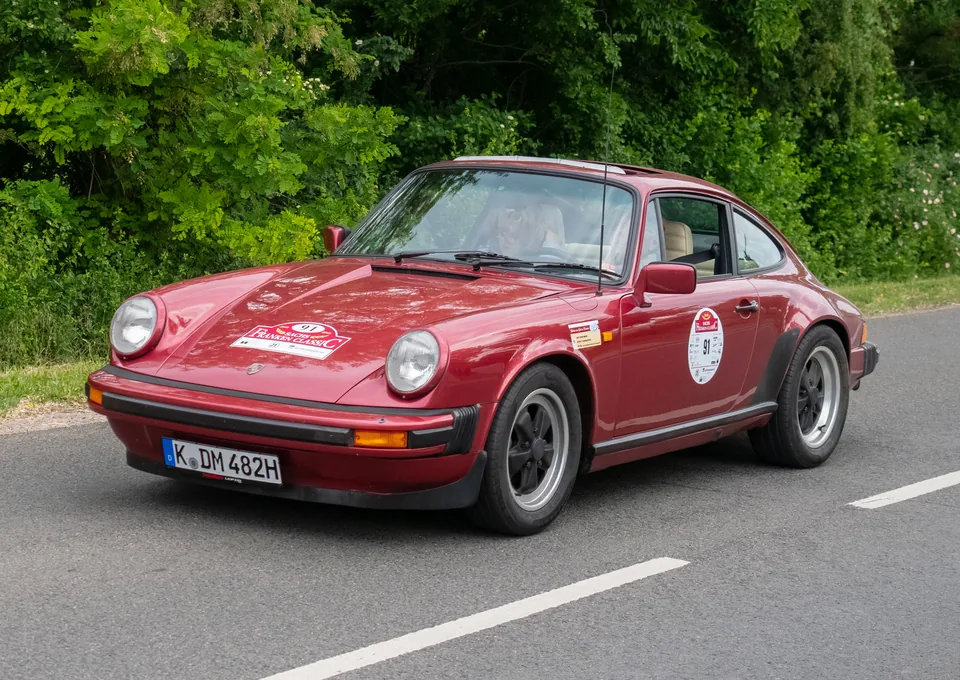
Porsche 911 SC
Why 6.0: An unblown version of the Turbo's 3.0-litre case, torsion bars, a 915 gearbox and no assistance anywhere — the impact-bumper 911 at its most robust. More than 60,000 were built, which is the whole reason this generation is still allowed out in the rain.
Layout
Natural habitat
Ride comfort
Sound
The 3.0 air-cooled flat-six has the metallic, fan-driven rasp no water-cooled engine reproduces, and an SC is identifiable from streets away. It is capped by 6,500 rpm, which ends the run before the top-end wail properly arrives.
6-cylinder · naturally aspirated · 6,500 rpm redline · rated 8.1 / 10 for engine sound
Market value
Median asking price, good condition · €25k (1980) → €66k (2026), trending up · illustrative data
Child seats · ISOFIX
Built before ISOFIX existed, so there are no anchor points at all. A child seat here is a seatbelt installation, and the belt geometry of the period was not designed with one in mind.
Derived from production years and seating layout, not a per-car source. ISOFIX was standardised as ISO 13216 in 1997, required on new EU model types from 2011 and on all new EU cars from 2014.
The long version
The SC arrived when Porsche was seriously considering killing the 911 altogether in favour of the 928, and it ended up doing the opposite: the galvanised shell, the reworked 3.0 engine and the eventual 204 hp made it the most durable air-cooled 911 to that point, and demand for it is a large part of why the model survived. Values roughly doubled through the air-cooled run-up of the last decade, but the SC never became a speculative instrument the way a 2.7 RS or a 964 RS did, because there are simply too many of them. What that leaves is unusual for a fifty-year-old Porsche: a car expensive enough to look after and common enough to use, so a meaningful share of the fleet still turns up at tours, classic rallies and winter drives rather than at auctions.