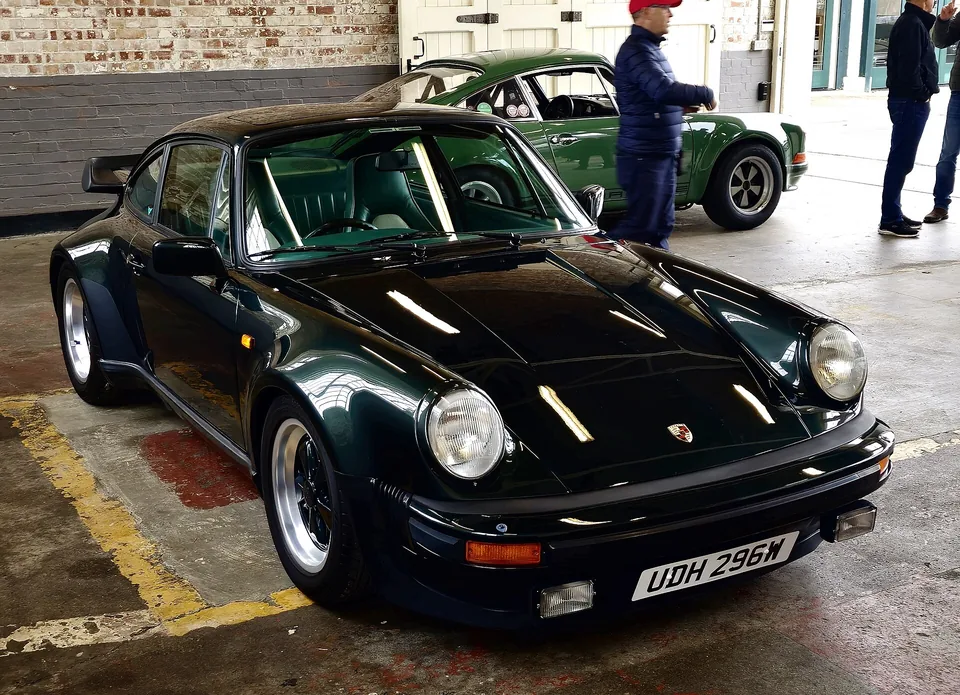
Porsche 911 Turbo (930)
Why 5.3: One large KKK turbocharger hung off an engine mounted behind the rear axle, no boost control beyond the driver's right foot, and four widely spaced gears. That combination punished anyone who lifted mid-corner and gave the 911 Turbo its widowmaker reputation for two decades. Around 21,000 were built, which is why it is still a car people drive rather than only collect.
Layout
Natural habitat
Ride comfort
Sound
Nothing else layers a crank-driven cooling fan, mechanical injection clatter and one large KKK turbo spooling audibly behind the rear axle. But a single big turbocharger is an extremely effective silencer and 6,800 rpm ends the climb early, so this is whoosh and hiss where the SC gives you a hard flat-six wail.
6-cylinder · turbocharged · 6,800 rpm redline · rated 7.4 / 10 for engine sound
Market value
Median asking price, good condition · €44k (1981) → €115k (2026), trending up · illustrative data
Child seats · ISOFIX
Built before ISOFIX existed, so there are no anchor points at all. A child seat here is a seatbelt installation, and the belt geometry of the period was not designed with one in mind.
Derived from production years and seating layout, not a per-car source. ISOFIX was standardised as ISO 13216 in 1997, required on new EU model types from 2011 and on all new EU cars from 2014.
The long version
Porsche built the 930 to homologate a turbocharged 911 for Group 4 racing and then found a market that did not care about racing at all. The 1975 car used 3.0 litres and 260 PS with no intercooler; from 1978 it grew to 3.3 litres, gained an intercooler under the enlarged tea-tray spoiler and made 300 PS in European trim, and it kept its four-speed gearbox until a G50 five-speed finally arrived for the 1989 model year. The reputation comes from three things interacting rather than any one of them: a single large turbo that does almost nothing until 3,000 rpm and then delivers everything at once, an engine hung out behind the rear axle, and no electronic assistance of any kind. Get all three wrong together and the car rotates. Porsche withdrew it from the United States after 1979 on emissions grounds and did not return until 1986, which is why American 930s cluster at both ends of the run. What keeps the ownership numbers respectable is volume. Roughly 21,000 were built across fifteen years, so there is a deep parts supply, a large specialist trade and enough cars that they have not all been absorbed into collections. The early 3.0 cars and the final G50 examples have gone that way; the mass of mid-run 3.3 coupes between them are still toured, still used, and still occasionally frightening their owners on a damp roundabout.