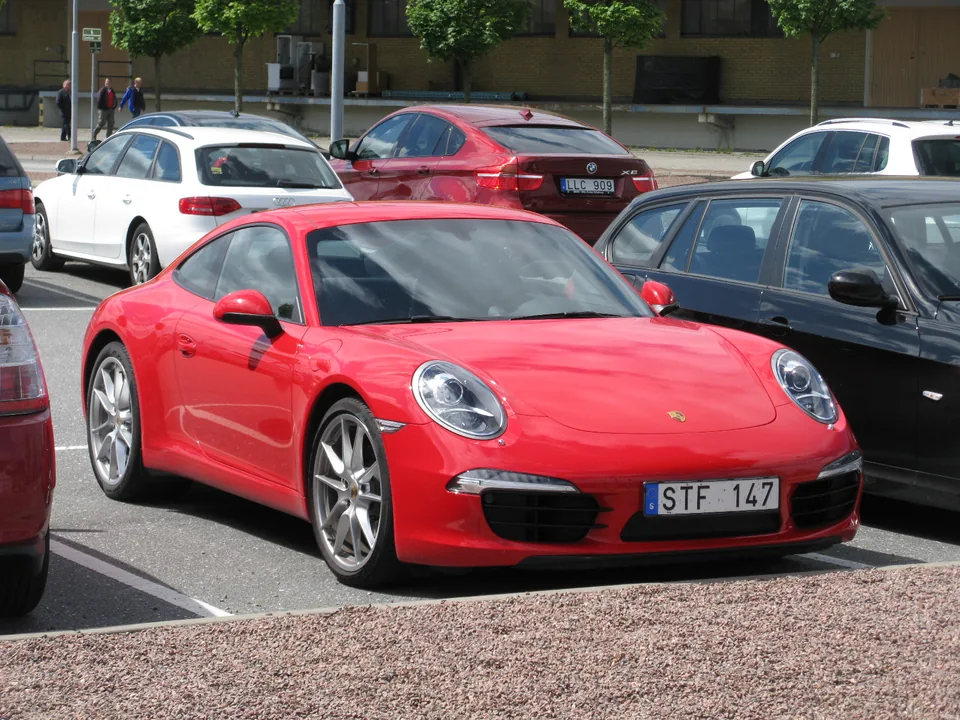
Porsche 911 Carrera (991.1)
Why 8.1: A 3.4-litre naturally aspirated flat-six to 7,800 rpm, the first seven-speed manual fitted to a production car, and a 100 mm longer wheelbase that finally let a 911 settle on the motorway. The base car got the narrow body, 19-inch wheels and black calipers, and gave away nothing that matters below 100 mph.
Layout
Natural habitat
Ride comfort
Sound
The 3.4 is the smallest of the 9A1 flat-sixes and spins to 7,800 rpm with nothing boosted in the way, so the hard-edged climb survives all the way up. But Porsche muffled the base car more than the S and the sports exhaust was a cost option, so much of it stays in the engine bay. The last base Carrera to sound like one.
6-cylinder · naturally aspirated · 7,800 rpm redline · rated 7.1 / 10 for engine sound
Market value
Median asking price, good condition · €75k (2012) → €52k (2026), trending down · illustrative data
Child seats · ISOFIX
Two ISOFIX positions on the outer rear seats — jump seats, so the question is whether the seat physically fits behind a front occupant, not whether the anchors are there.
The rear anchors are the supported route — the manual points child seats there, and front-passenger ISOFIX is the exception rather than the rule. A belt-mounted seat up front needs the airbag off, and cars with a rear row don't always fit a deactivation switch, precisely because the rear seats exist.
Derived from production years and seating layout, not a per-car source. ISOFIX was standardised as ISO 13216 in 1997, required on new EU model types from 2011 and on all new EU cars from 2014.
The long version
The 991 was the biggest rethink of the 911 since the 996 — a new aluminium-steel body, electric power steering, a wider front track — and the base Carrera was where most of them went. It was also the car the press told you to skip in favour of the S, which has kept it cheap. Seven-speed manuals are rarer than PDKs, the 3.4 is the least powerful engine Porsche has put in a 991, and the market has priced it accordingly: a well-kept early car costs less than a new Golf R. That is the ownership story in one line. There is no allocation game, no limited run and no auction narrative, so the people who own one bought it to drive, and the mileage on the used market shows it. The 991.2 facelift replaced the 3.4 with a turbocharged 3.0 in 2016, which has started to pull the naturally aspirated cars toward enthusiast garages — but slowly, and from a very low base.