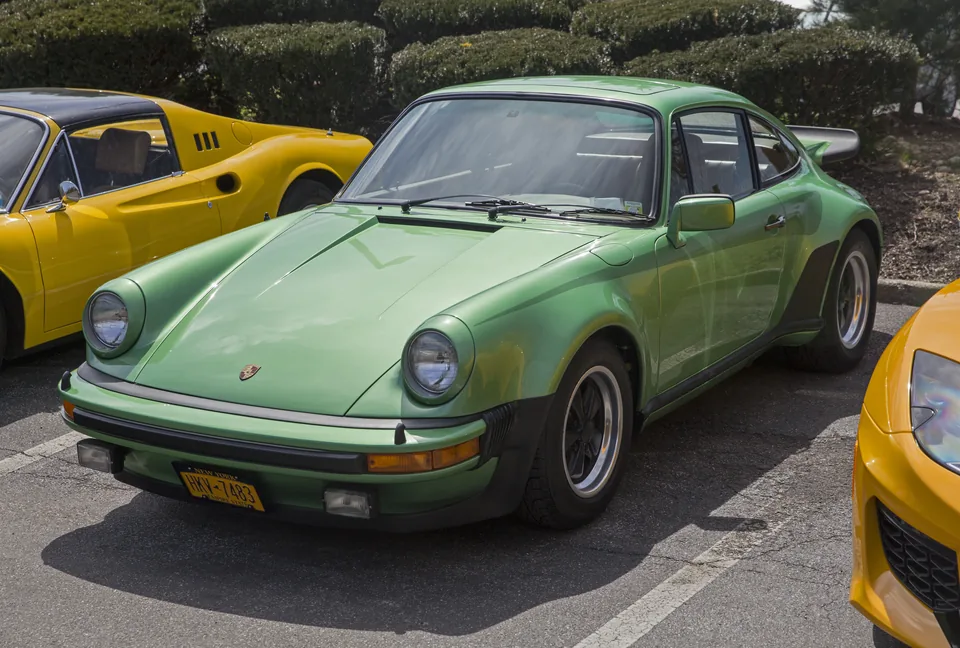
Porsche 911 Turbo 3.0 (930)
Why 3.8: A single KKK turbocharger on the 3.0 Carrera engine, no intercooler, 260 hp arriving all at once above 4,000 rpm, a four-speed gearbox because the five-speed could not take the torque, and the flat whale tail and wide arches that defined the 911 Turbo for forty years. Porsche built it to homologate the 934 and 935, priced it as the fastest road car in Germany, and sold 2,819 of them before the 3.3 with its intercooler and tea tray took over in 1978.
Layout
Natural habitat
Ride comfort
Sound
A single KKK turbo on a 3.0 with no intercooler, so the boost noise is unfiltered: whoosh, a long sigh on lift, injection chatter underneath. But the flat-six wail sits behind the turbine, as in every turbocharged 911, and the 3.3's extra displacement gives it more bass, which puts this a tenth below it. Whoosh and clatter.
6-cylinder · turbocharged · 6,800 rpm redline · rated 7.3 / 10 for engine sound
Market value
Median asking price, good condition · €24k (1976) → €179k (2026), trending up · illustrative data
Child seats · ISOFIX
Built before ISOFIX existed, so there are no anchor points at all. A child seat here is a seatbelt installation, and the belt geometry of the period was not designed with one in mind.
Derived from production years and seating layout, not a per-car source. ISOFIX was standardised as ISO 13216 in 1997, required on new EU model types from 2011 and on all new EU cars from 2014.
The long version
The 3.0 Turbo is where the collector market and the driver market separate inside the same badge. The 3.3 was built for twelve years and nearly 19,000 cars, which keeps it a usable classic; the 3.0 was built for three and fewer than 3,000, which makes it the one the auction houses want. Values moved through $150,000 during the air-cooled boom and the best early cars have gone past $250,000, so what was once the cheapest 930 is now the dearest. The ownership record follows: these are museum-loan and concours cars, sold on with the original toolkit and the Porsche Certificate of Authenticity, and a car with more than 50,000 miles is the exception. Owners who do drive them do so carefully, because the lag that made the car's reputation is still there and the market now punishes a stone chip. Low usage from the owners, not low drama from the car — the 3.0 is the purest expression of the first Turbo and the one most likely to be parked.