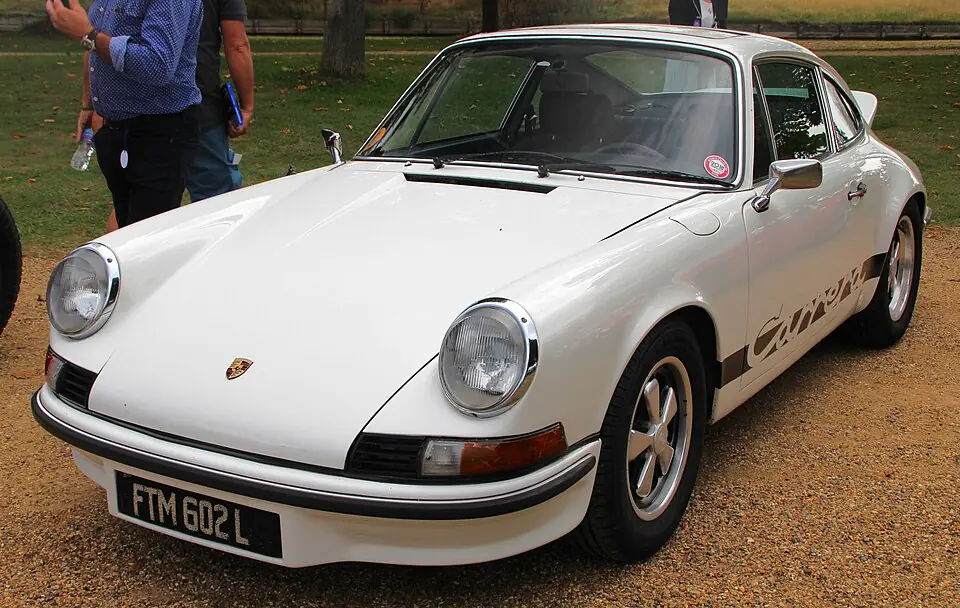
Porsche 911 Carrera 2.7 RS
Why 5.3: 975 kilograms, a ducktail spoiler added specifically to cure high-speed lift, and a 210-hp flat-six that made this the lightest, most focused 911 Porsche had built to that point — every RS badge since 1973 has been chasing this car's reputation. It was built to homologate a racer, and Porsche's own RS/GT3 owner culture keeps that heritage alive: Rennsport Reunion grids are full of them, and real ones still turn laps, not just odometer miles.
Layout
Natural habitat
Ride comfort
Sound
Mechanical fuel injection with individual trumpets, a cooling fan driven off the crank, and in Sport Lightweight form almost no deadening between the flat-six and the cabin. But 2.7 litres and 7,300 rpm cannot sustain the climb a modern GT3 manages, which places it just under the 992.
6-cylinder · naturally aspirated · 7,300 rpm redline · rated 8.7 / 10 for engine sound
Market value
Median asking price, good condition · €9k (1972) → €782k (2026), trending up · illustrative data
Child seats · ISOFIX
Built before ISOFIX existed, so there are no anchor points at all. A child seat here is a seatbelt installation, and the belt geometry of the period was not designed with one in mind.
Derived from production years and seating layout, not a per-car source. ISOFIX was standardised as ISO 13216 in 1997, required on new EU model types from 2011 and on all new EU cars from 2014.
The long version
Porsche needed 500 road cars to homologate a Group 4 racer and built the lightest, most direct 911 the factory had ever offered to get there — thinner glass, deleted sound-deadening, a rear spoiler added mid-development purely to tame the standard car's high-speed lift. That the ducktail became one of the most recognizable silhouettes in motorsport was a side effect, not the plan. Values sat at used-911 money into the 1990s, which meant an entire generation of Porsche enthusiasts learned to drive fast on real roads and real racetracks in real RS 2.7s before the market caught up; that driving culture — Rennsport Reunion, vintage racing, serious club track days — never really faded even as the money involved now makes most owners think twice before a wet Tuesday commute.