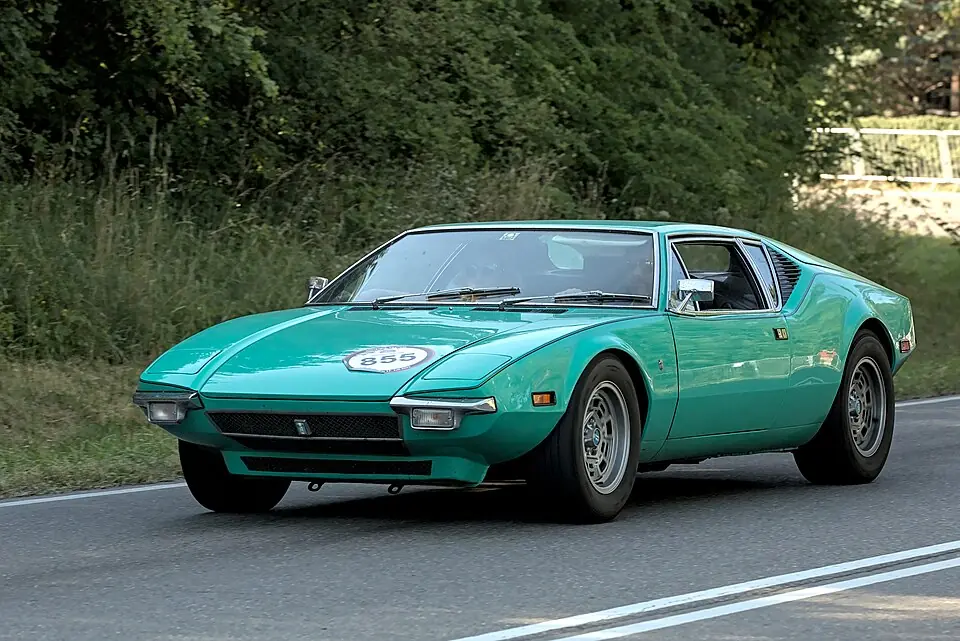
De Tomaso Pantera
Why 5.3: A mid-mounted Ford 351 Cleveland under Tom Tjaarda's Italian bodywork means a Pantera owner can get parts at a normal auto parts store and find a mechanic who isn't booked out eighteen months — a genuinely different ownership proposition from every V12 Italian exotic on this shelf. Ford marketed it through Lincoln-Mercury dealers as an exotic for under $10,000, and the mechanical simplicity that made that price possible is still why these get driven more than their badge would suggest.
Layout
Natural habitat
Ride comfort
Sound
A 351 Cleveland sits directly behind the cabin with a thin bulkhead and no meaningful insulation, so the boomy American V8 arrives at close range. But it is a mass-produced pushrod engine capped at 6,000 rpm, and the Italian body does nothing to refine what it hears.
8-cylinder · naturally aspirated · 6,000 rpm redline · rated 7.1 / 10 for engine sound
Market value
Median asking price, good condition · €9k (1971) → €110k (2026), trending up · illustrative data
Child seats · ISOFIX
Built before ISOFIX existed, so there are no anchor points at all. A child seat here is a seatbelt installation in the only passenger seat there is.
Derived from production years and seating layout, not a per-car source. ISOFIX was standardised as ISO 13216 in 1997, required on new EU model types from 2011 and on all new EU cars from 2014.
The long version
Ford's pitch was audacious even by early-1970s standards — an Italian-styled, mid-engine exotic sold and serviced through Lincoln-Mercury showrooms, backed by a small-block V8 any Ford mechanic already understood. Reliability problems and the 1974 oil shock ended the US partnership after a rocky few years, and values cratered for a decade afterward as the car fell into an awkward gap: too exotic for muscle-car buyers, too American for exotic-car buyers. That two-decade slump is exactly what built its current ownership culture — Panteras attracted people who wanted to actually drive a mid-engine exotic on a mechanic's budget, and the parts-bin driveline means owners today still do their own service more than most cars on this list. It's the rare car here whose relative affordability is the whole point, not a market failure to be corrected.