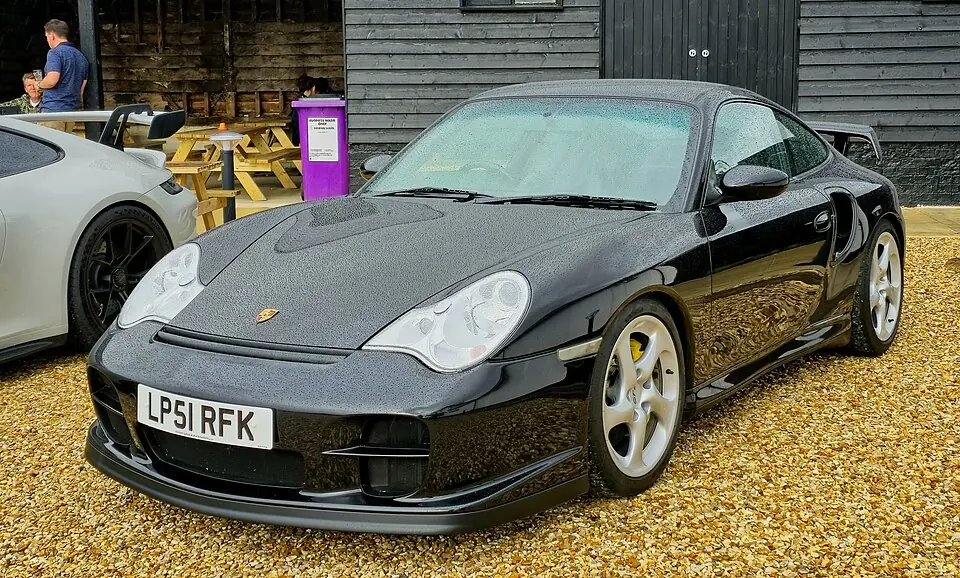
Porsche 911 GT2 (996)
Why 4.8: RWD only, no traction control, and enough turbo lag to catch a distracted driver mid-corner — Porsche built the GT2 with every safety net the Turbo offered stripped out on purpose. The reputation is earned, not marketing; that's also why it's respected rather than flipped.
Layout
Natural habitat
Ride comfort
Sound
The Mezger flat-six whistles and sighs through its wastegates with almost no insulation between it and your back. But the turbos smother the top end and the flat-six's own hard-edged note barely gets out, so it is boost noise more than engine noise.
6-cylinder · turbocharged · 7,000 rpm redline · rated 6.8 / 10 for engine sound
Market value
Median asking price, good condition · €170k (2003) → €262k (2026), trending up · illustrative data
Child seats · ISOFIX
There aren't any — strict two-seater.
The GT2 came with sport/bucket-style seats as standard, which Porsche's rule excludes from child-seat use — and multiple 996 owners report no ISOFIX fitting in their cars at all, regardless of seat choice.
Porsche Club GB and Rennlist 996-era owner reports on GT2/GT3 seats and ISOFIX (owner-community sourced, not manufacturer documentation)
The long version
Porsche took the 911 Turbo's twin-turbo flat-six, pulled the front axle to save weight, and sent it out with no traction control and no stability system standing between the driver and 483 hp of boost arriving all at once — a deliberate decision to build the rawest, most demanding 911 in the lineup rather than the fastest one on paper. That combination earned it the widowmaker reputation almost immediately, and it is not an exaggeration passed down by forum lore; period road tests describe exactly the snap-oversteer character the nickname implies. Values spiked hard during the broader air-cooled and early-water-cooled 911 boom, corrected some afterward, and have settled into a slow climb as the population of stock, unmodified cars keeps shrinking. Owners tend to hold rather than flip it — this is a car bought for what it represents as much as what it does, and most of what's left in private hands stays parked more than driven, brought out by people who respect exactly how little margin for error it offers.