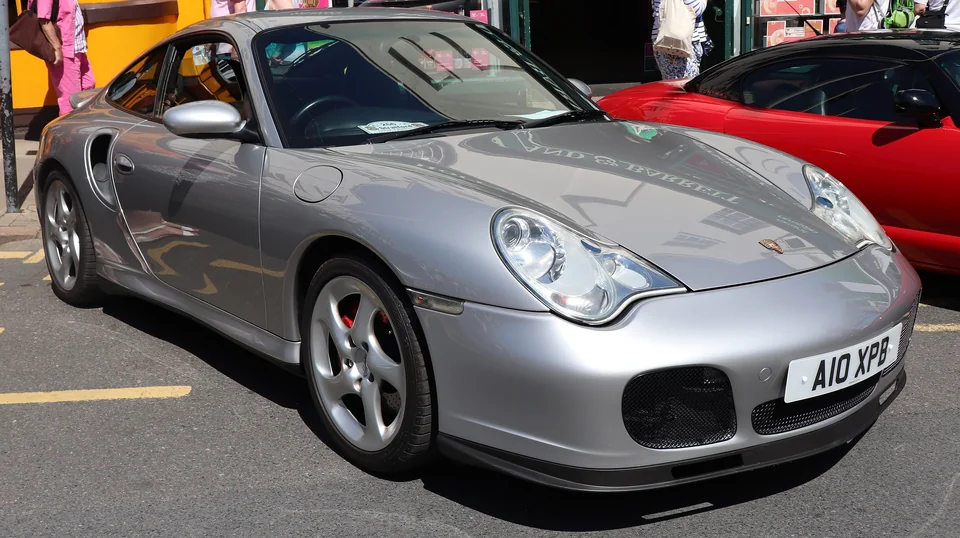
Porsche 911 Turbo (996)
Why 7.8: The 996 Turbo does not use the M96 engine that gave the water-cooled 911 its reputation for eating intermediate shafts. It uses the Mezger — a dry-sump crankcase derived from the 911 GT1 race programme, shared with the GT3 and the GT2 — and it is the reason a twenty-five-year-old turbocharged Porsche is a sane thing to drive every day.
Layout
Natural habitat
Ride comfort
Sound
The Mezger flat-six keeps its hard air-cooled-descendant edge, and the twin KKKs add real whoosh and blow-off hiss over your shoulder. But the turbos smother exactly the top end that makes a GT3 special, and 6,750 rpm is a short run. Fast rather than tuneful.
6-cylinder · turbocharged · 6,750 rpm redline · rated 6.6 / 10 for engine sound
Market value
Median asking price, good condition · €102k (2001) → €69k (2026), trending down · illustrative data
Child seats · ISOFIX
ISOFIX was spreading through these years rather than fitted across the board — whether a given car has rear anchors depends on its year and market.
Children were expected in the back. Front-passenger ISOFIX effectively didn't exist in this era, and airbag deactivation was patchy — treat the front seat as a no unless a specific car proves otherwise.
Derived from production years and seating layout, not a per-car source. ISOFIX was standardised as ISO 13216 in 1997, required on new EU model types from 2011 and on all new EU cars from 2014.
The long version
Sold new, the 996 Turbo was a $111,000 car that did 0-60 in the low fours and had four-wheel drive, which made it the fast Porsche you could use in February. Sold used, it became something more unusual: the cheap 911 Turbo, sitting in the high thirties by 2013 while the air-cooled market went vertical around it. That price, combined with the Mezger engine's genuine robustness, produced an owner body unlike almost any other Porsche on this list — people who bought them specifically to drive hard, tracked them, put six-figure mileages on them, and were relaxed about it because the car had already done its depreciating and the engine was not going to fail the way the naturally aspirated cars sometimes did. The fried-egg headlights and the shared 996 Carrera nose kept the collector market away for a decade longer than they should have. That has begun to change: clean manual coupes now trade in the seventies and rising, which is what pulls the flip factor back from where it sat five years ago. But most 996 Turbos have well over 60,000 miles on them and the culture around the car is still overwhelmingly about using it. It is one of the few genuinely fast Porsches where a high-mileage example is not considered a problem.