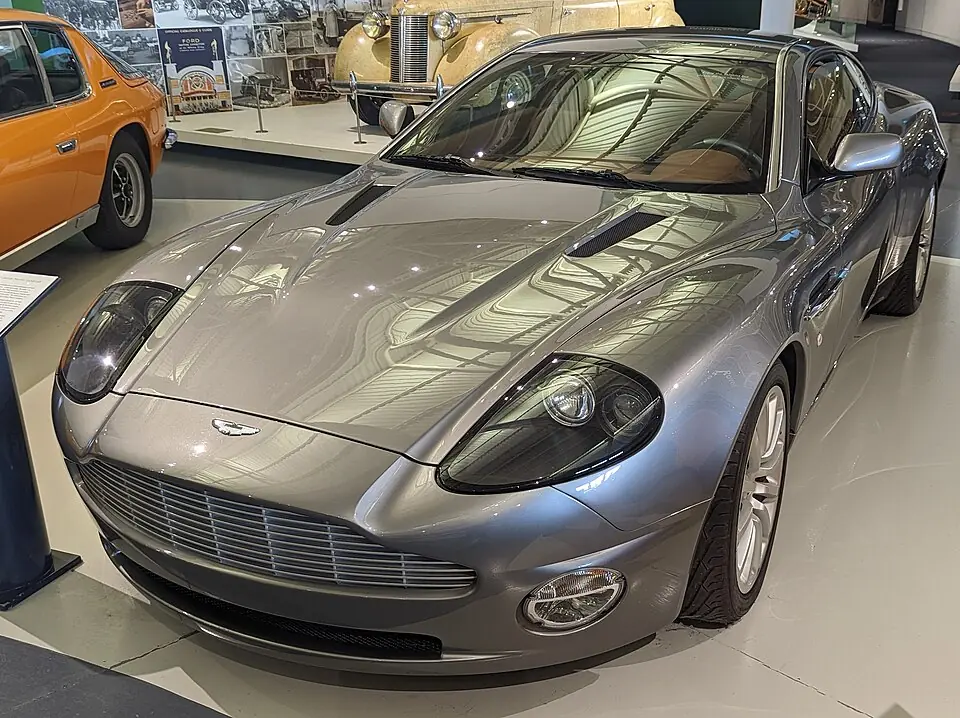
Aston Martin Vanquish
Why 5.0: Aston's first V12 flagship paired a genuinely great naturally aspirated engine with a single-clutch automated manual that testers called slow even when new — a real limiter on how much the car gets driven hard today. Values bottomed out over a decade ago and have only recently started climbing as the last hand-built Newport Pagnell Astons get rediscovered.
Layout
Natural habitat
Ride comfort
Sound
The 5.9 V12 has a hard-edged bellow Aston never quite repeated, with nothing between it and the exhaust. But 7,000 rpm and a heavy GT's insulation cap it, and the paddle gearbox keeps interrupting the build. Outstanding, still short of the Ferrari twelves.
12-cylinder · naturally aspirated · 7,000 rpm redline · rated 8.1 / 10 for engine sound
Market value
Median asking price, good condition · €214k (2003) → €87k (2026), trending down · illustrative data
Child seats · ISOFIX
Every ISOFIX part number and "mandatory equipment" reference filed under the Vanquish name turns out to be for the 2012-on second-generation car — this 2001–2007 original predates that by a decade.
Aston Martin's own rule is that ISOFIX bars only go on non-height-adjustable passenger seats; this car's power sport seat is height-adjustable, so it doesn't get them.
Nameplate trap: parts catalogs list "Vanquish" ISOFIX brackets without flagging that they only fit 2012+ cars.
PistonHeads Aston Martin forum + Scuderia Car Parts / Eurospares fitment listings (2012+ only) (owner-community sourced, not manufacturer documentation)
The long version
The original Vanquish was Aston Martin's first proper V12 flagship, hand-assembled at Newport Pagnell with a bonded aluminum chassis and a naturally aspirated 5.9-liter V12 that period reviewers genuinely loved — right up until they had to describe the single-clutch automated gearbox, which nobody loved, then or since. That gearbox is the reason this never built the driver's-car reputation its engine deserved; the shifts were slow enough that owners learned to lift and wait rather than fight it, and the car settled into life as a comfortable, torquey grand tourer instead of anything sharper. Values collapsed through the 2000s and 2010s as depreciation did what it does to every flagship GT, bottoming out around the mid-2010s before the last-of-Newport-Pagnell story started pulling early Astons back into collector conversations. What's on the road today splits between owners who bought cheap and drive it as the V12 cruiser it always was, and a smaller group holding out for the values to keep climbing.