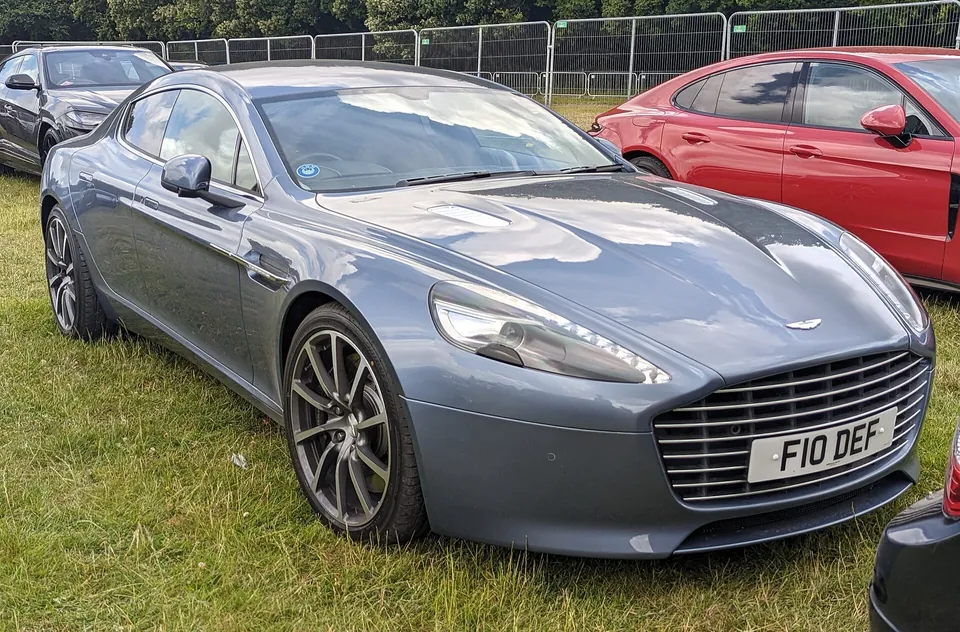
Aston Martin Rapide
Why 6.7: Aston's aluminium VH platform stretched into a four-door, with the 5.9-litre V12 behind the front axle and the gearbox at the back — 470 hp, close to 2,000 kg, and a rear seat an adult can genuinely sit in. It depreciated harder than almost anything else Aston has built, which handed the model to a second wave of owners who bought a used V12 GT and use it like one.
Layout
Natural habitat
Ride comfort
Sound
The 5.9 naturally aspirated V12 opens its bypass valves into a hard, layered wail to 7,000 that nothing turbocharged reproduces. But this is the saloon, tuned and insulated for four people, so it is a softer version of what the DBS does with the same engine.
12-cylinder · naturally aspirated · 7,000 rpm redline · rated 7.6 / 10 for engine sound
Market value
Median asking price, good condition · €187k (2011) → €57k (2026), trending down · illustrative data
Child seats · ISOFIX
Two ISOFIX positions on the outer rear seats, the outer pair being the ones the standard covers.
The rear anchors are the supported route — the manual points child seats there, and front-passenger ISOFIX is the exception rather than the rule. A belt-mounted seat up front needs the airbag off, and cars with a rear row don't always fit a deactivation switch, precisely because the rear seats exist.
Derived from production years and seating layout, not a per-car source. ISOFIX was standardised as ISO 13216 in 1997, required on new EU model types from 2011 and on all new EU cars from 2014.
The long version
Marek Reichman's team began designing the Rapide in 2005 and the prototype appeared at Detroit in January 2006, but production did not start until May 2010, and then at Magna Steyr in Austria — until Aston pulled the work back to Gaydon in 2012 as demand for luxury saloons fell short of the plan. The 5.9-litre V12 makes 470 hp at 6,000 rpm and 600 Nm at 5,000, sitting behind the front axle line with a rear transaxle to keep the balance near even despite the length, driving through a six-speed ZF Touchtronic II until 2014 and an eight-speed thereafter. What Car? admired the engine and had reservations about most of the rest, and the market broadly agreed: the Rapide never sold in the numbers Aston needed, and a car listing north of $200,000 shed most of that inside five years. That collapse is the entire ownership story. The people driving Rapides today did not pay $200,000; they paid a fraction of it, and they bought a naturally aspirated V12 four-seat Aston as a usable car rather than an appreciating one. Nobody is storing one, so it picks up real mileage doing the job it was designed for — which, after a decade of depreciation, has finally become a rational purchase.