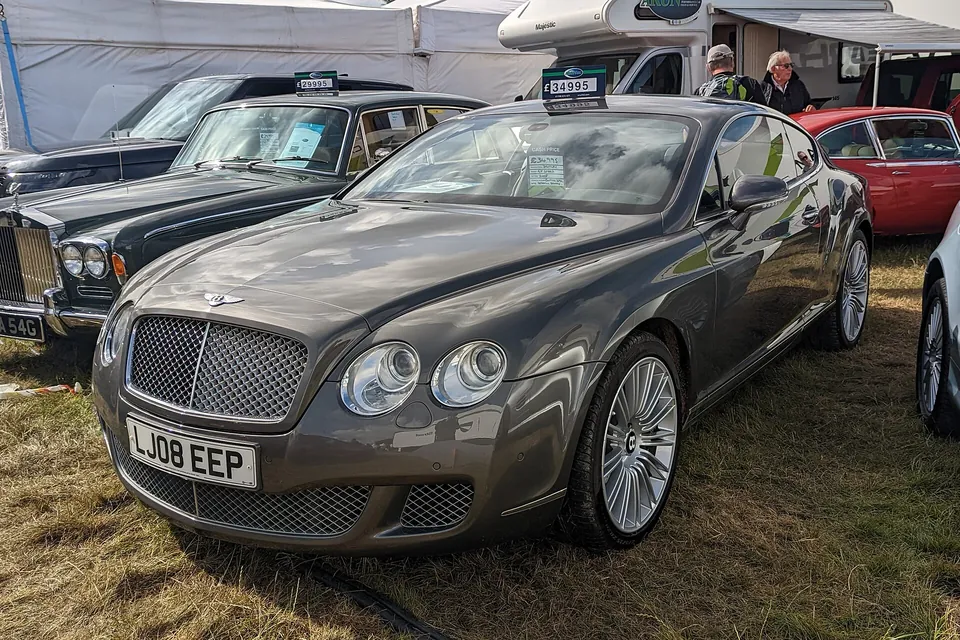
Bentley Continental GT Speed
Why 5.3: Bentley's first Continental GT Speed took the W12 to 608 PS and 750 Nm, dropped the ride height, firmed the dampers, and became the first production Bentley past 200 mph. It is still a 2,350 kg grand tourer bought largely for what it says in a hotel forecourt — but the Speed is the version its owners actually drive, and after fifteen years of depreciation the ones buying now are not the ones who paid $195,000.
Layout
Natural habitat
Ride comfort
Sound
There is a distant twelve-cylinder woofle and a faint whistle from the turbos when you lean on it. But Bentley built the W12 to be inaudible, and between the boost, the insulation and a 6,000 rpm limit there is almost nothing left to hear.
12-cylinder · turbocharged · 6,000 rpm redline · rated 5.2 / 10 for engine sound
Market value
Median asking price, good condition · €179k (2008) → €57k (2026), trending down · illustrative data
Child seats · ISOFIX
Two ISOFIX positions on the outer rear seats, the outer pair being the ones the standard covers.
The rear anchors are the supported route — the manual points child seats there, and front-passenger ISOFIX is the exception rather than the rule. A belt-mounted seat up front needs the airbag off, and cars with a rear row don't always fit a deactivation switch, precisely because the rear seats exist.
Derived from production years and seating layout, not a per-car source. ISOFIX was standardised as ISO 13216 in 1997, required on new EU model types from 2011 and on all new EU cars from 2014.
The long version
The Continental GT rescued Bentley commercially, and the Speed was the 2007 answer to buyers who wanted the W12 to be more than a very fast sofa: 608 PS in place of 560, 750 Nm of torque, a lowered ride height, uprated springs and dampers, and a 202 mph top speed that made it the first production Bentley beyond 200. Everything underneath is Volkswagen Group engineering at a scale nobody else was attempting — six litres, twelve cylinders arranged in a W, two turbochargers, all-wheel drive and a ZF six-speed automatic hauling around roughly 2,350 kg. The honest read is that most Continental GTs are bought for presence rather than for driving, and this index scores the base car accordingly; the Speed sits above it because the buyers who specifically chose the harder version tended to care about the road as well as the arrival. Depreciation has been ruthless in the way it always is for complex twelve-cylinder flagships: a car listing near $195,000 new can now be had for mid-range-SUV money, with a maintenance bill that keeps casual buyers away. What that filters for is an owner who understands the running costs and accepts them, which is why the Speed collects more genuine mileage than its badge would suggest — even though nobody would call it a driver's car.