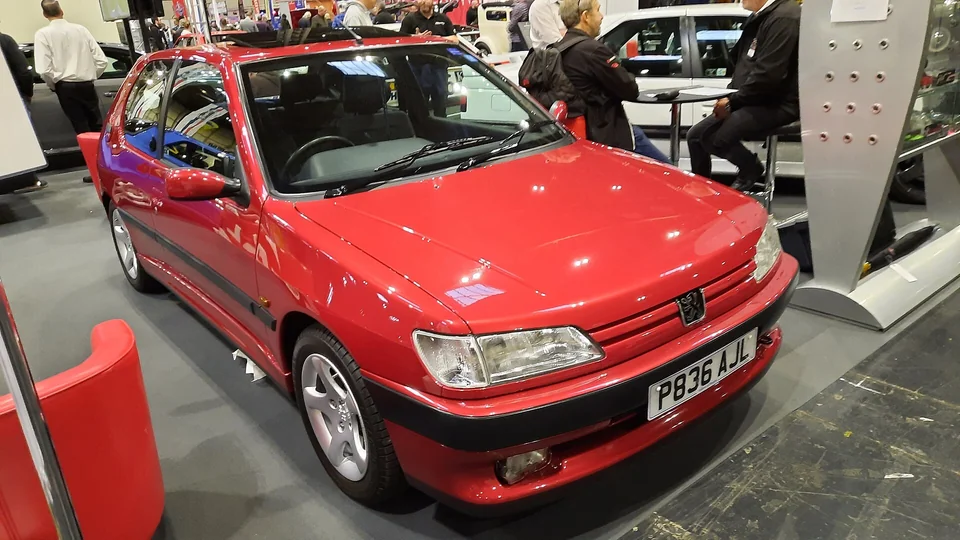
Peugeot 306 GTi-6
Why 8.1: Peugeot put a close-ratio six-speed behind a 167 bhp naturally aspirated two-litre and hung it on a torsion beam whose geometry turns the back of the car into the corner with you — the chassis every late-nineties hot-hatch comparison measured itself against. Cheap for two decades, so almost all of them were driven into the ground; the survivors are only now being looked after.
Layout
Natural habitat
Ride comfort
Sound
The XU10J4RS hardens noticeably past 5,000 and pulls cleanly to 7,200, which is more character than most French fours ever found. But it is an ordinary two-litre sixteen-valve on a standard exhaust, so it is keen rather than memorable.
4-cylinder · naturally aspirated · 7,200 rpm redline · rated 6.3 / 10 for engine sound
Market value
Median asking price, good condition · €25k (1997) → €16k (2026), trending down · illustrative data
Child seats · ISOFIX
ISOFIX was spreading through these years rather than fitted across the board — whether a given car has rear anchors depends on its year and market.
Children were expected in the back. Front-passenger ISOFIX effectively didn't exist in this era, and airbag deactivation was patchy — treat the front seat as a no unless a specific car proves otherwise.
Derived from production years and seating layout, not a per-car source. ISOFIX was standardised as ISO 13216 in 1997, required on new EU model types from 2011 and on all new EU cars from 2014.
The long version
The GTi-6 is the 306 S16 with the reworked XU10J4RS engine making 167 bhp instead of 155, and a close-ratio six-speed gearbox at a point when six speeds in a family hatchback was still a supercar affectation. What made its reputation was not the engine but the back axle: a passive torsion beam set up so the rear wheels steer very slightly into the corner as the car loads up, which is why period road tests kept describing the steering as coming from both ends at once. Peugeot left the American market in 1991, five years before this existed, so the whole story is European — and for twenty years it was simply the cheap way to own a great chassis, which meant these were bought by young drivers, tracked, modified, crashed and scrapped in enormous numbers. Values bottomed out near banger money in the mid-2010s and have climbed hard since, driven by the realisation that an unmodified one with honest history is now genuinely rare. They are still being driven, though: nobody has ever bought a 306 as an investment, and the running costs of a twenty-five-year-old French hatchback keep the speculators out.