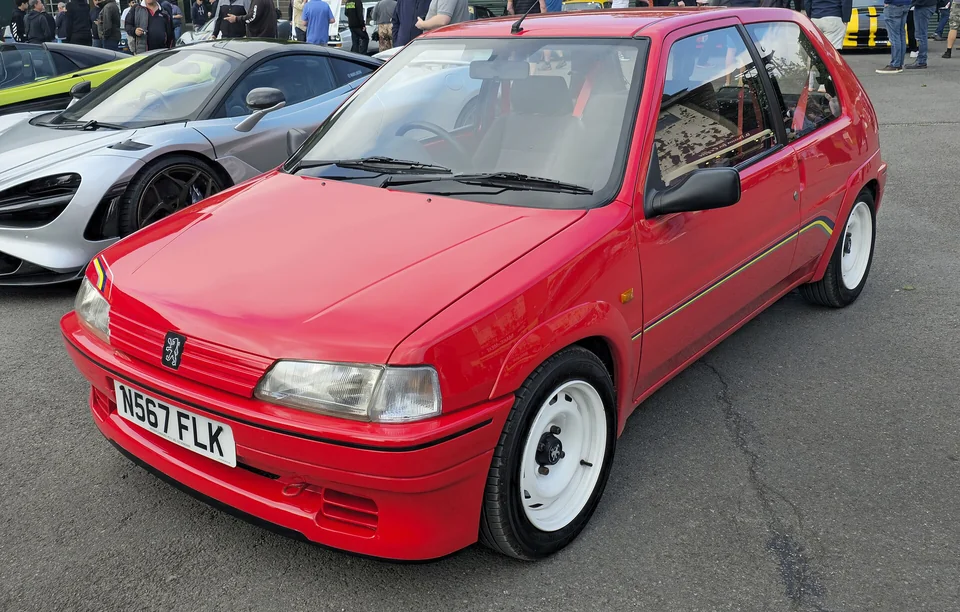
Peugeot 106 Rallye
Why 7.9: Peugeot Sport sized the engine at 1,294 cc for one reason — to drop under the FIA's 1.3-litre rally ceiling — then deleted everything that added mass: no power steering, painted steel wheels, no sound deadening worth the name. One of the very few homologation specials still cheap enough that owners race and hillclimb them instead of storing them.
Layout
Natural habitat
Ride comfort
Sound
With 825 kg and no soundproofing, the little eight-valve sits right in the cabin and revs happily to 7,200. But an eight-valve 1.3 is a plain, thrashy thing — you hear it because Peugeot deleted the insulation, not because it sings.
4-cylinder · naturally aspirated · 7,200 rpm redline · rated 5.6 / 10 for engine sound
Market value
Median asking price, good condition · €15k (1994) → €17k (2026), trending up · illustrative data
Child seats · ISOFIX
ISOFIX was spreading through these years rather than fitted across the board — whether a given car has rear anchors depends on its year and market.
Children were expected in the back. Front-passenger ISOFIX effectively didn't exist in this era, and airbag deactivation was patchy — treat the front seat as a no unless a specific car proves otherwise.
Derived from production years and seating layout, not a per-car source. ISOFIX was standardised as ISO 13216 in 1997, required on new EU model types from 2011 and on all new EU cars from 2014.
The long version
The 1,294 cc capacity is not an engineering coincidence. Peugeot Sport took the existing TU four and shortened the stroke from 77 mm to 73.2 mm purely to bring it under the 1.3-litre class limit in Group N rallying, where a very light car with modest power could win outright. Everything else followed: no power steering, steel wheels, minimal trim, and a kerb weight of 825 kg that no modern supermini gets remotely close to. On the road it is far better than the numbers suggest, because 100 PS arriving at 7,200 rpm in a car this light means you use all of it all of the time — a completely different experience from having twice as much and never seeing the limiter. Values collapsed through the 2000s the way every cheap French hatchback's did, and a great many were rallied to destruction or rusted away before anyone thought of them as collectible; what is left has climbed steeply since about 2018. Even so, this remains the rare homologation car whose owners still enter it in events rather than trailer it to a concours lawn. A 106 Rallye that never gets driven has missed the entire point of itself.