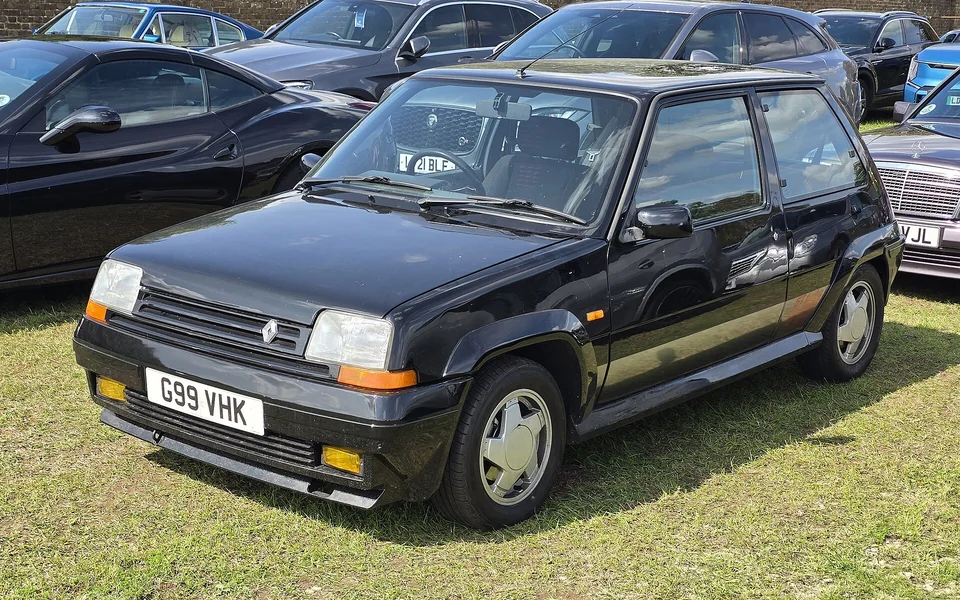
Renault 5 GT Turbo
Why 7.1: Not the mid-engined Group 4 monster — the front-drive one ordinary people could afford. 1,397 cc, a turbocharger sized with no restraint whatsoever, and only 830 kg to move. The boost arrives all at once, which is exactly what made its name and also why so few survived their first decade intact.
Layout
Natural habitat
Ride comfort
Sound
The Cléon-Fonte pushrod 1.4 disappears behind a Garrett sized for a much bigger engine, leaving spool, wastegate hiss and induction. But the engine underneath is thin and thrashy to 5,750 rpm, so it lands in the turbo-character band rather than anywhere musical.
4-cylinder · turbocharged · 5,750 rpm redline · rated 5.0 / 10 for engine sound
Market value
Median asking price, good condition · €12k (1986) → €29k (2026), trending up · illustrative data
Child seats · ISOFIX
Built before ISOFIX existed, so there are no anchor points at all. A child seat here is a seatbelt installation, and the belt geometry of the period was not designed with one in mind.
Derived from production years and seating layout, not a per-car source. ISOFIX was standardised as ISO 13216 in 1997, required on new EU model types from 2011 and on all new EU cars from 2014.
The long version
This is the car most people actually mean when they say Renault 5 Turbo, and it shares almost nothing with the mid-engined homologation special of the same era beyond a silhouette and a badge. The GT Turbo is built on the ordinary front-drive Supercinq, with a blown 1,397 cc pushrod four making 115 PS and later 120 in the Phase 2 cars. What it has is a power-to-weight ratio that embarrassed things costing four times as much, and a delivery that lands in one lump past about 3,500 rpm — which in a car this short and this light is either the appeal or the problem, depending on the road and the driver. Renault never brought the second-generation 5 to America; only the earlier Le Car made the crossing under the AMC alliance, so the entire ownership history is European. It also had a hard life: cheap, quick, easy to modify and irresistible to young drivers, which is why so many were crashed, over-boosted or simply rusted through. Clean unmolested cars have gone from banger money to serious classic prices inside a decade, and there is now a visible split between the examples being preserved and the ones still used as intended. The market is only just tipping toward the former.