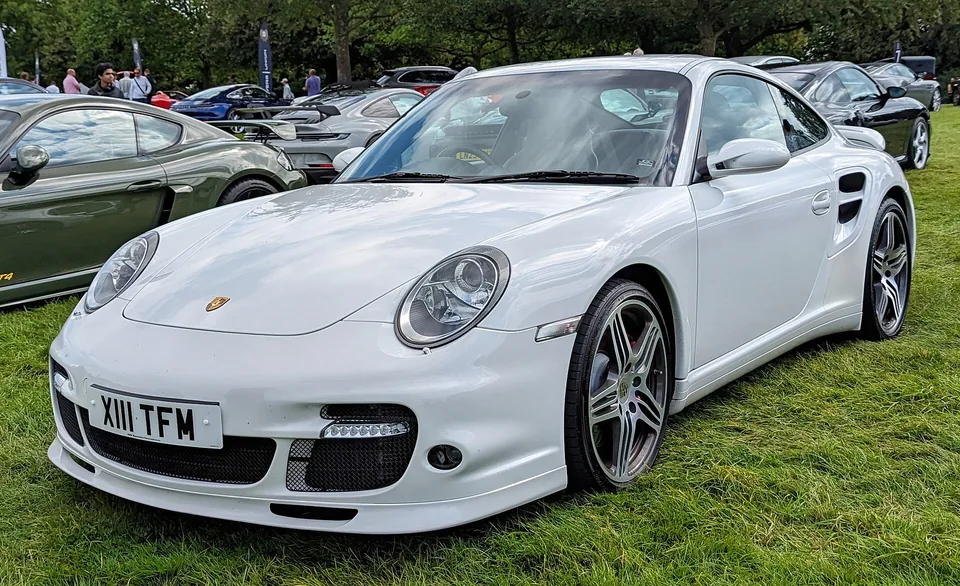
Porsche 911 Turbo (997)
Why 7.4: The 997.1 Turbo carries the last Mezger-block turbocharged engine, breathing through the first variable-geometry turbochargers fitted to a petrol production car and driving all four wheels through Porsche Traction Management. The 997.2 of 2010 moved to the direct-injection 9A1 with 500 hp and PDK, and became faster and more ordinary at the same time.
Layout
Natural habitat
Ride comfort
Sound
The 997.1 is the last Turbo with the Mezger block, and its variable-geometry turbochargers add a sharper spool whistle than the 996's fixed-vane units. But two turbochargers and 6,750 rpm smother the flat-six's top end, so you hear induction rush more than engine. The 997.2's 9A1 is quieter still.
6-cylinder · turbocharged · 6,750 rpm redline · rated 6.7 / 10 for engine sound
Market value
Median asking price, good condition · €113k (2007) → €87k (2026), trending down · illustrative data
Child seats · ISOFIX
Two ISOFIX positions on the outer rear seats — jump seats, so the question is whether the seat physically fits behind a front occupant, not whether the anchors are there.
The rear anchors are the supported route — the manual points child seats there, and front-passenger ISOFIX is the exception rather than the rule. A belt-mounted seat up front needs the airbag off, and cars with a rear row don't always fit a deactivation switch, precisely because the rear seats exist.
Derived from production years and seating layout, not a per-car source. ISOFIX was standardised as ISO 13216 in 1997, required on new EU model types from 2011 and on all new EU cars from 2014.
The long version
Every 911 Turbo since the 993 has been bought by the same person: someone who wants supercar numbers and will use them in February. The 997 is the generation where that was most true, because it arrived with a 3.7-second 0–60 time, a rear seat, a six-speed manual and the reliability record of the Mezger engine, and then depreciated to the price of a new Cayman. The result is a fleet that has been driven — hard, in all weathers, often as the only car — and a market that only recently began to separate the 997.1 manuals as the collectable end. The Mezger connection does the work there: the 997.1 is the last 911 Turbo with the GT1-derived block, and as the GT3s went up in price the Turbo was pulled along. The 997.2's 9A1 engine and PDK are the better daily combination and the cheaper one, which is where the miles still go. The score reflects the whole population, not the handful of delivery-mile manuals now sitting in dehumidified storage.