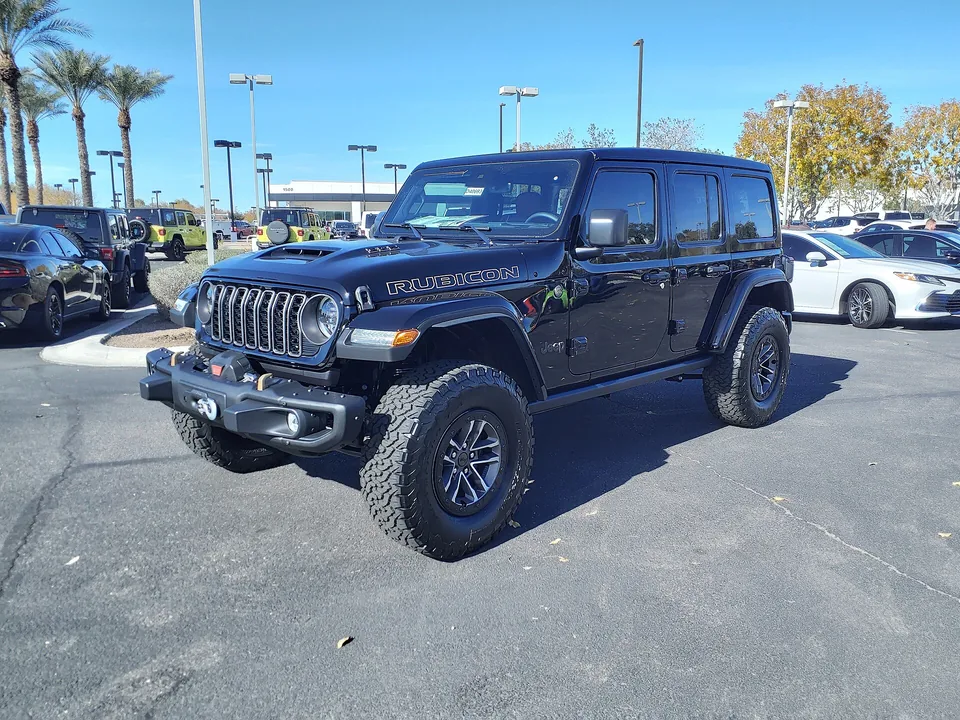
Jeep Wrangler Rubicon 392
Why 6.3: Jeep answered the Bronco by dropping the 392 Hemi into a Wrangler and lifting it two inches: 470 hp, a functional hood scoop that doubles as a snorkel, solid axles at both ends and a disconnecting front anti-roll bar. It is absurd and it is also a genuinely capable Rubicon.
Layout
Natural habitat
Ride comfort
Sound
The 6.4 Hemi runs a dual-mode exhaust, and nothing else here lets you remove the doors, the roof and the windscreen from between the engine and your ears. But it is a cross-plane pushrod V8 stopping at 6,000 rpm, so it is bark rather than anything intricate.
8-cylinder · naturally aspirated · 6,000 rpm redline · rated 6.6 / 10 for engine sound
Market value
Median asking price, good condition · €68k (2021) → €63k (2026), trending down · illustrative data
Child seats · ISOFIX
Two ISOFIX positions on the outer rear seats, the outer pair being the ones the standard covers.
The rear anchors are the supported route — the manual points child seats there, and front-passenger ISOFIX is the exception rather than the rule. A belt-mounted seat up front needs the airbag off, and cars with a rear row don't always fit a deactivation switch, precisely because the rear seats exist.
Derived from production years and seating layout, not a per-car source. ISOFIX was standardised as ISO 13216 in 1997, required on new EU model types from 2011 and on all new EU cars from 2014.
The long version
The Rubicon 392 arrived in 2021 at a shade over $74,000 and sold out immediately, with the usual consequences — dealer markups, order-book flipping, and a secondary market above list for the first two years. What separates it from the ordinary launch-hype car is what happened afterwards. Wranglers are modified rather than traded; the aftermarket is enormous, the platform has barely changed in structure since 2018, and owners tend to keep them through several rounds of tyres and lift kits. So the 392 settled into being used: not as a daily for most, because 13 mpg and a 27-gallon tank make that a decision, but as a second vehicle that actually goes places. The counterweight is the 2025 Final Edition, which Jeep announced as the last of the V8 Wranglers and which is being bought and stored rather than driven — a small, clearly identifiable slice of the fleet behaving like a collectible. Everything under it is a Wrangler that still gets wheeled, which is why the two ownership factors land close together rather than splitting the way a launch-markup car usually does.