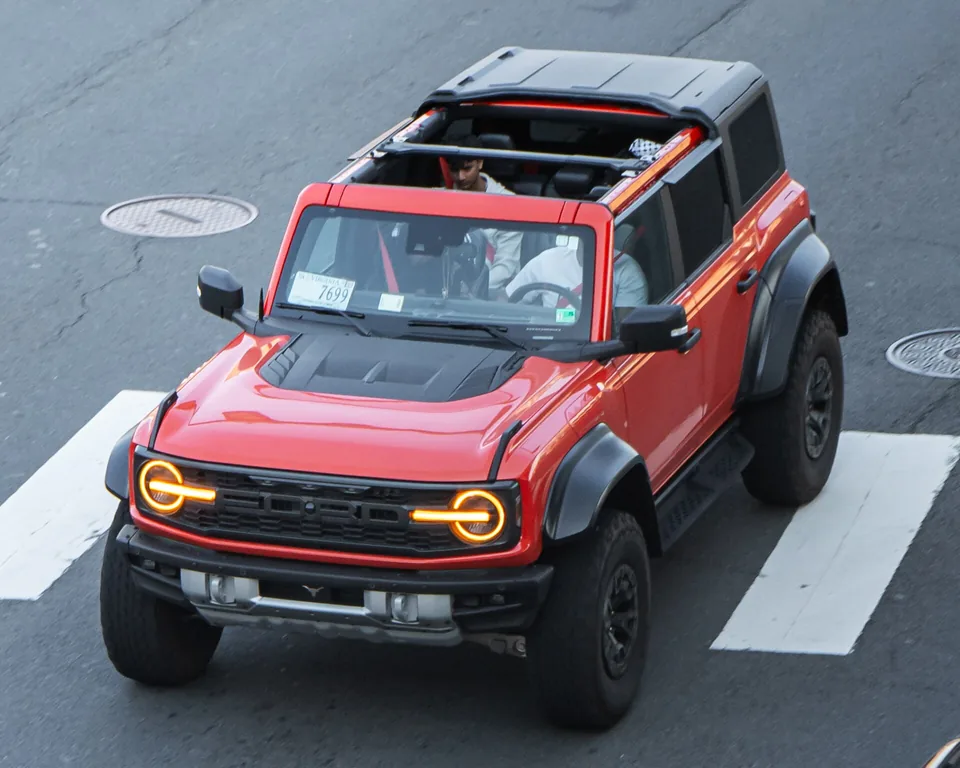
Ford Bronco Raptor
Why 6.1: 37-inch tyres as standard, Fox Live Valve internal-bypass dampers, a track widened by 8.6 inches over a standard Bronco, and 418 hp from the 3.0-litre EcoBoost. It is engineered around suspension travel rather than lap time, which is a rarer brief than it sounds.
Layout
Natural habitat
Ride comfort
Sound
The 3.0 EcoBoost has an active exhaust and a genuine turbo flutter, which is more effort than most trucks make. But a twin-turbo V6 dragging a desert racer sounds mostly of boost and wind, and Ford could not disguise that the note belongs to no engine in particular.
6-cylinder · turbocharged · 6,000 rpm redline · rated 5.4 / 10 for engine sound
Market value
Median asking price, good condition · €64k (2022) → €55k (2026), trending down · illustrative data
Child seats · ISOFIX
Two ISOFIX positions on the outer rear seats, the outer pair being the ones the standard covers.
The rear anchors are the supported route — the manual points child seats there, and front-passenger ISOFIX is the exception rather than the rule. A belt-mounted seat up front needs the airbag off, and cars with a rear row don't always fit a deactivation switch, precisely because the rear seats exist.
Derived from production years and seating layout, not a per-car source. ISOFIX was standardised as ISO 13216 in 1997, required on new EU model types from 2011 and on all new EU cars from 2014.
The long version
Ford priced the Bronco Raptor at $70,095 in 2022 and then watched dealers add twenty and thirty thousand on top, which is exactly the behaviour this index is built to catch. Early transactions and the first year of resale look like pure speculation. What it did not do was stay that way: production caught up, the markups evaporated, and by 2025 a used Bronco Raptor was worth meaningfully less than its window sticker — the point at which the people holding one are the people who wanted one. And they use them. The car is too wide for a multi-storey and returns 15 mpg on a good day, so it is almost never anybody's only vehicle, but its natural habitat is a two-hour drive from where its owner lives and the odometers reflect that. It sits below the Wrangler 392 here for one reason: the Jeep has fifteen years of accumulated keep-it-forever ownership culture behind it, and the Raptor's first two years were spent being traded.