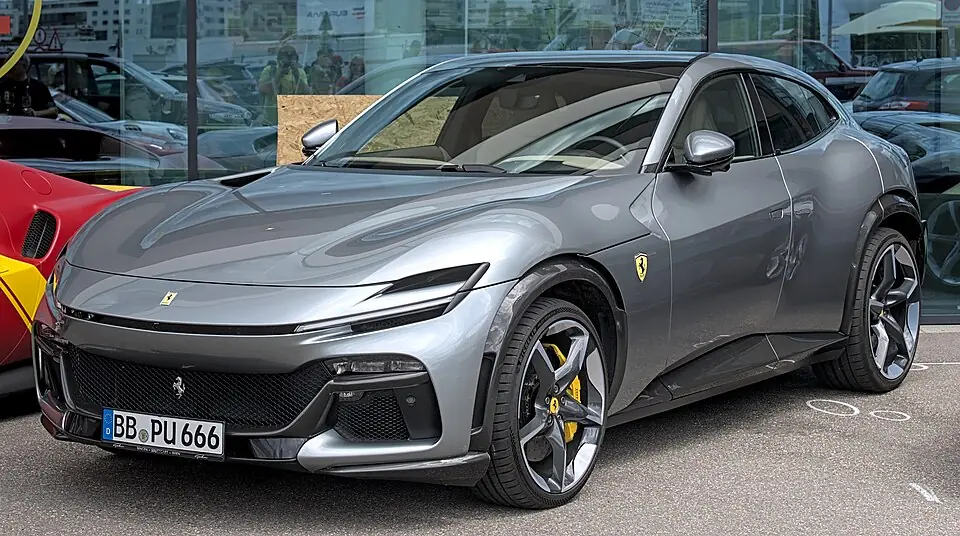
Ferrari Purosangue
Why 3.0: Ferrari's engineers did everything right — a real NA V12, real balance — and the order book did everything predictable: allocation-gated, traded above sticker, parked outside the right restaurants. The involvement is genuine; the ownership isn't about it.
Layout
Natural habitat
Ride comfort
Sound
A 6.5 naturally aspirated V12 to 8,250 rpm in a family car, with a genuine hard-edged top end when it is working. But the valved exhaust stays shut at low load and the particulate filter takes the rasp off. A great V12 filtered through SUV manners.
12-cylinder · naturally aspirated · 8,250 rpm redline · rated 7.7 / 10 for engine sound
Market value
Median asking price, good condition · €460k (2023) → €423k (2026), trending down · illustrative data
Child seats · ISOFIX
Two ISOFIX positions on the outer rear seats, the outer pair being the ones the standard covers.
The rear anchors are the supported route — the manual points child seats there, and front-passenger ISOFIX is the exception rather than the rule. A belt-mounted seat up front needs the airbag off, and cars with a rear row don't always fit a deactivation switch, precisely because the rear seats exist.
Derived from production years and seating layout, not a per-car source. ISOFIX was standardised as ISO 13216 in 1997, required on new EU model types from 2011 and on all new EU cars from 2014.
The long version
Allocation went first to existing multi-Ferrari clients, so the earliest Purosangues landed in garages already stocked with 812s and F8s — a fourth or fifth car, not a daily gamble. Dealer markups over sticker persisted well past launch, and a visible share of the early build has already changed hands for a premium rather than logged real mileage. The rear-hinged doors and the school-run practicality get used exactly as advertised; the V12 mostly gets used as a talking point at pickup.