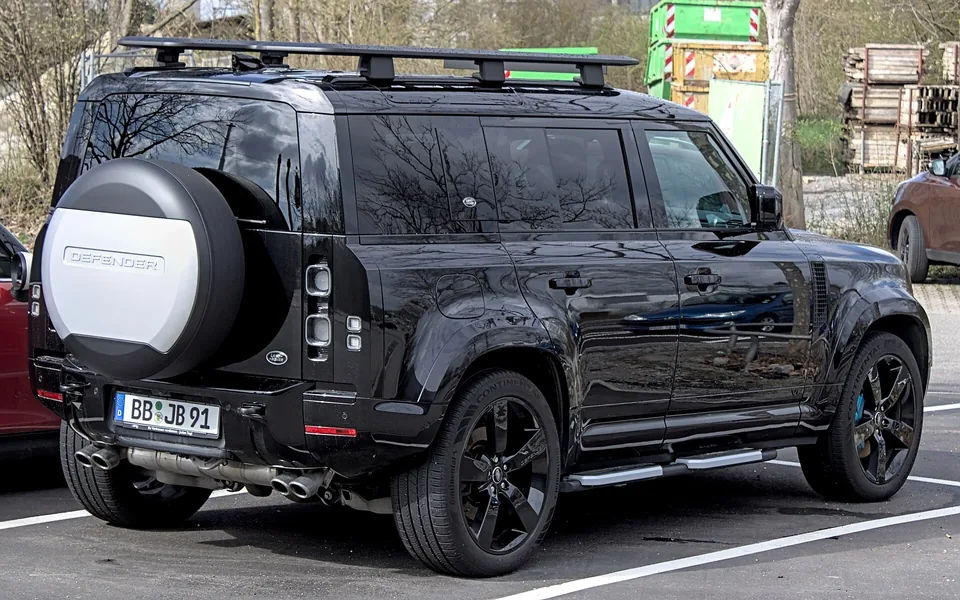
Land Rover Defender 110 V8 (L663)
Why 5.9: Land Rover's 5.0-litre supercharged V8 in the D7x-platform Defender: 518 hp, quad exhausts, a retuned air suspension and an electronic active differential. It shares a name and nothing else with the ladder-frame Defender that ended in 2016.
Layout
Natural habitat
Ride comfort
Sound
The supercharged 5.0 gets a quad-exit exhaust that JLR's SV team tuned to crack on the overrun, and the boxy body drums it back rather than absorbing it. But the whine is doing more of the work than the V8 is, which puts it just below the F-Type.
8-cylinder · supercharged · 6,500 rpm redline · rated 6.5 / 10 for engine sound
Market value
Median asking price, good condition · €97k (2022) → €70k (2026), trending down · illustrative data
Child seats · ISOFIX
Two ISOFIX positions on the outer rear seats, the outer pair being the ones the standard covers.
The rear anchors are the supported route — the manual points child seats there, and front-passenger ISOFIX is the exception rather than the rule. A belt-mounted seat up front needs the airbag off, and cars with a rear row don't always fit a deactivation switch, precisely because the rear seats exist.
Derived from production years and seating layout, not a per-car source. ISOFIX was standardised as ISO 13216 in 1997, required on new EU model types from 2011 and on all new EU cars from 2014.
The long version
This is the L663, the aluminium-monocoque Defender launched in 2020, and the V8 is the version Land Rover added in 2022 when it became clear how many buyers wanted the look with a supercharger under it. The distinction matters: the pre-2020 Defender is a separate vehicle with a separate ownership culture, and conflating them produces nonsense in both directions. The L663 V8 is bought and used as an expensive daily — school runs, motorways, the occasional field — and the mileage figures are respectable because it is comfortable enough to be someone's main car in a way the old one never was. Where it loses ground is retention. It launched allocation-constrained, the Carpathian and Trophy editions were traded rather than driven, and Land Rover's reliability record does the rest: a meaningful share of first owners exit at the end of the warranty, which is a different thing from a car that gets handed down. Depreciation has been steep enough that the second-owner market is now the interesting one, and those cars get driven harder than the first-owner fleet ever did.