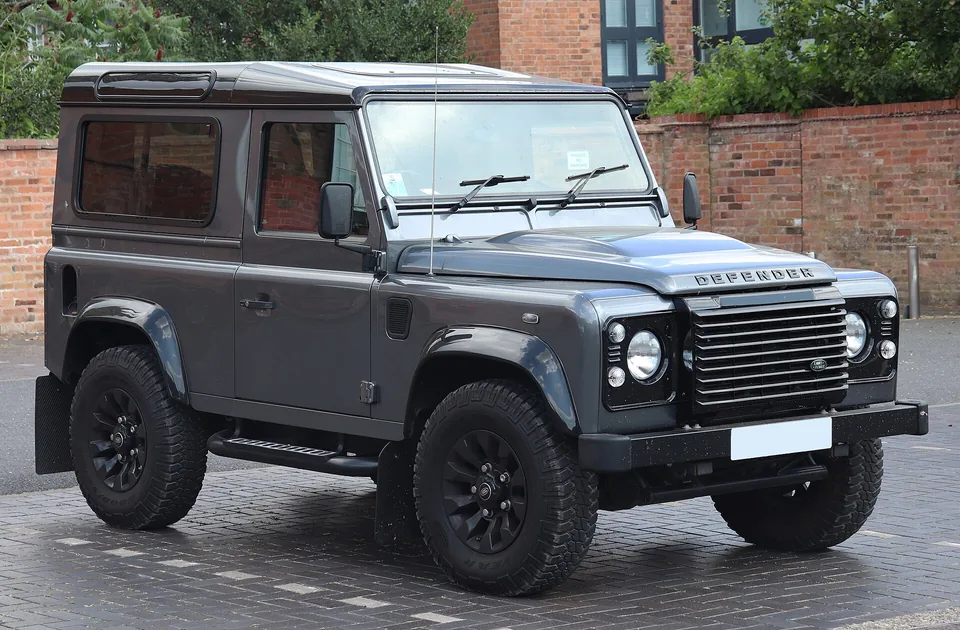
Land Rover Defender 90 (classic)
Why 7.9: Land Rover attached the Defender name in 1990 to a vehicle whose basic architecture dated to 1948, and then changed almost nothing for twenty-six years: ladder frame, aluminium panels, live axles at both ends, permanent four-wheel drive. The short-wheelbase 90 is the one people actually want.
Layout
Natural habitat
Ride comfort
Sound
The 300Tdi clatters at idle in a way that is genuinely part of the car's character, and the turbo whistles over the top of it. But it is a four-cylinder diesel to 4,500 rpm in a body with no insulation, so what reaches you is noise rather than note.
4-cylinder · turbocharged · 4,500 rpm redline · rated 3.4 / 10 for engine sound
Market value
Median asking price, good condition · €39k (2015) → €52k (2026), trending up · illustrative data
Child seats · ISOFIX
ISOFIX was spreading through these years rather than fitted across the board — whether a given car has rear anchors depends on its year and market.
Children were expected in the back. Front-passenger ISOFIX effectively didn't exist in this era, and airbag deactivation was patchy — treat the front seat as a no unless a specific car proves otherwise.
Derived from production years and seating layout, not a per-car source. ISOFIX was standardised as ISO 13216 in 1997, required on new EU model types from 2011 and on all new EU cars from 2014.
The long version
Production ended on 29 January 2016 with the 2,016,933rd Land Rover, and the entire ownership story of this vehicle is contained in the gap between how it was used for most of those twenty-six years and what has happened since that date. For most of them it was a tool. Farms, estates, aid agencies, mountain rescue and the British Army bought Defenders because they were repairable in a field with hand tools, and the mileages reflect a working life rather than a hobby — the fact that it is loud, slow, cold and uncomfortable at any speed above 60 mph never mattered to a buyer choosing it on capability. Then the end of production turned the last cars into instant collectables. Late Heritage and Autobiography editions were bought and stored, prices for clean low-mileage 90s roughly doubled, and in the United States — where the NAS Defender 90 was sold officially only from 1994 to 1997 — the combination of scarcity and the twenty-five-year import rule has produced six-figure asking prices for vehicles that were work trucks everywhere else. That speculative tail is real and it is why this sits below the Land Cruiser rather than beside it. Underneath it is still a very large fleet of Defenders being driven through mud by people who need them to be.