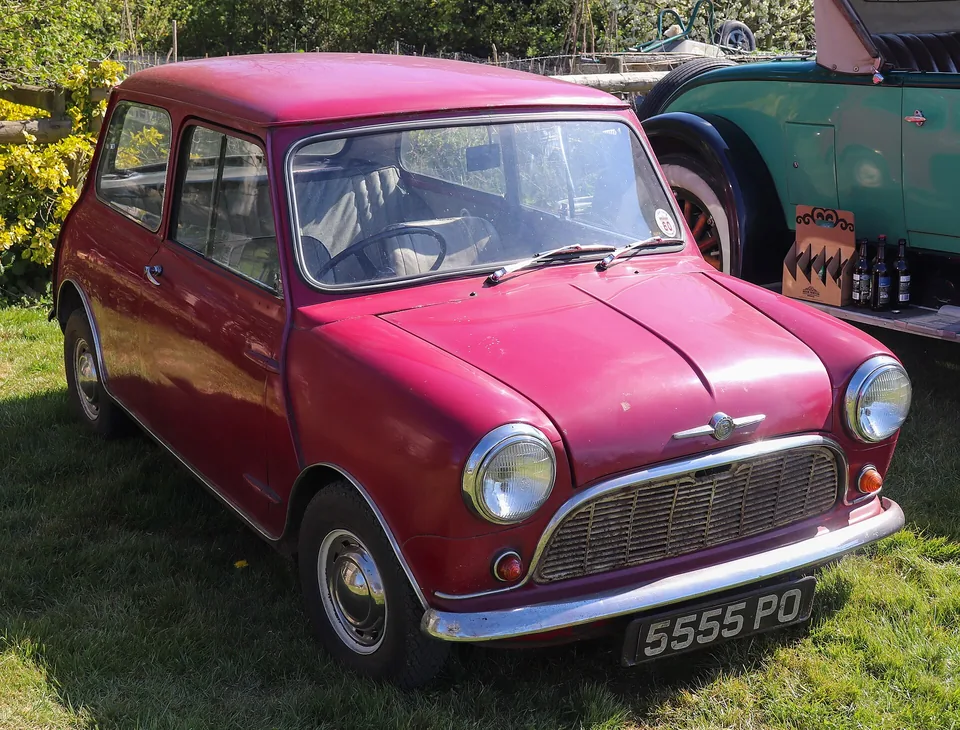
Mini (Issigonis original)
Why 7.7: Alec Issigonis turned the engine sideways, put the gearbox in the sump underneath it, pushed a wheel into each corner of a three-metre car and got four seats out of it. 34 hp, 585 kg, rubber-cone suspension, ten-inch wheels — and every transverse front-drive hatchback built since is a footnote to it.
Layout
Natural habitat
Ride comfort
Sound
Most of what you hear is the gearbox, because it lives in the sump and whines through every ratio — a noise no other small car makes. But the A-series itself is a buzzy pushrod four to 5,500 rpm, so this is transmission character rather than an engine worth listening to.
4-cylinder · naturally aspirated · 5,500 rpm redline · rated 5.2 / 10 for engine sound
Market value
Median asking price, good condition · €1k (1959) → €24k (2026), trending up · illustrative data
Child seats · ISOFIX
ISOFIX was spreading through these years rather than fitted across the board — whether a given car has rear anchors depends on its year and market.
Children were expected in the back. Front-passenger ISOFIX effectively didn't exist in this era, and airbag deactivation was patchy — treat the front seat as a no unless a specific car proves otherwise.
Derived from production years and seating layout, not a per-car source. ISOFIX was standardised as ISO 13216 in 1997, required on new EU model types from 2011 and on all new EU cars from 2014.
The long version
The Mini launched on 26 August 1959 as the Austin Seven and the Morris Mini-Minor, went on to sell an estimated 5.38 million over forty-one years, and was voted the second-most influential car of the twentieth century in the 1999 global poll, behind the Model T and ahead of the DS and the Beetle. What matters here is what owning one has been like for those forty-one years, and it divides cleanly. The Mini was cheap transport for its entire production life — sold new in North America as the Austin 850 and Morris 850 in the early sixties, sold everywhere else for decades to people buying the cheapest new car available — and it rusted with real enthusiasm, which is why the survival rate from the first twenty years is so poor. What survived did so because someone wanted it to. That is the defining fact: a classic Mini on the road in 2026 is there because a person spent money and weekends on a car worth less than the restoration, and cars kept that way are not traded. They are handed down, modified, rebuilt, driven on club runs and used as second cars, and the market for them has risen slowly and steadily for thirty years without a bubble — the exception being Cooper and Cooper S cars with competition history, a small and well-documented corner. Mileages sit below the batch's diesels because almost nobody uses one as a daily any more. Almost nobody sells one either.