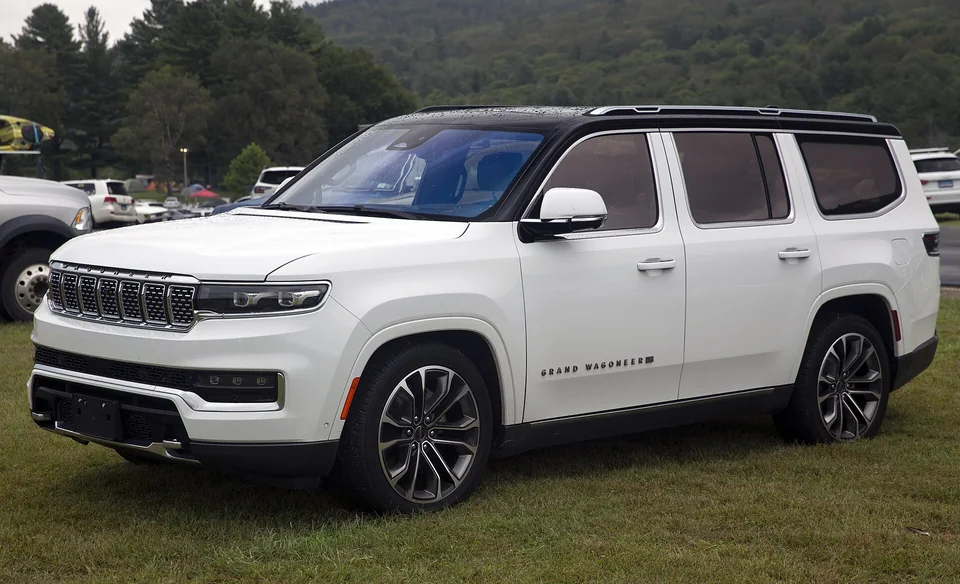
Jeep Grand Wagoneer
Why 7.8: Stellantis revived a name last used in 1991 and attached it to a three-tonne, three-row, body-on-frame SUV with a 471 hp 392 Hemi, air suspension, an independent rear axle and as many as seven screens — including one for the front passenger that the driver physically cannot see.
Layout
Natural habitat
Ride comfort
Sound
The 392 is the last big unblown Hemi Jeep sells, and at part throttle it delivers the offbeat cross-plane thrum no turbocharged eight reproduces, hardening properly past 4,000 rpm. But acoustic glass and active cancellation exist to protect the third row, and 5,800 rpm ends the climb early.
8-cylinder · naturally aspirated · 5,800 rpm redline · rated 5.8 / 10 for engine sound
Market value
Median asking price, good condition · €97k (2022) → €53k (2026), trending down · illustrative data
Child seats · ISOFIX
Two ISOFIX positions on the outer rear seats, the outer pair being the ones the standard covers.
The rear anchors are the supported route — the manual points child seats there, and front-passenger ISOFIX is the exception rather than the rule. A belt-mounted seat up front needs the airbag off, and cars with a rear row don't always fit a deactivation switch, precisely because the rear seats exist.
Derived from production years and seating layout, not a per-car source. ISOFIX was standardised as ISO 13216 in 1997, required on new EU model types from 2011 and on all new EU cars from 2014.
The long version
The Grand Wagoneer is what happens when a company works out that the profit in an SUV scales with the price and decides to find the ceiling. It is enormous, genuinely well finished inside, and priced from $88,000 to well past $110,000, which put it against the Escalade and the Range Rover rather than anything else with a Jeep grille on it — and Stellantis was careful to note that Wagoneer was a brand, not a Jeep model, precisely because it knew the badge could not carry the number. The market disagreed politely. Early cars had software and build-quality complaints, the 392's real-world consumption is close to thirteen miles per gallon, and the depreciation has been severe even by large-SUV standards: three-year-old examples are trading near half their sticker. That produces the ownership pattern this index likes. There is no speculation — nobody is banking a Wagoneer — and the people buying them second-hand at $60,000 are buying an enormous amount of family transport rather than an object. They do school runs, they tow, they carry seven. What keeps the mileage figure honest is the fuel bill and the fact that a $110,000 vehicle is rarely a household's only one. This is a trophy that turned into a bus, which is the best thing that can happen to it here.