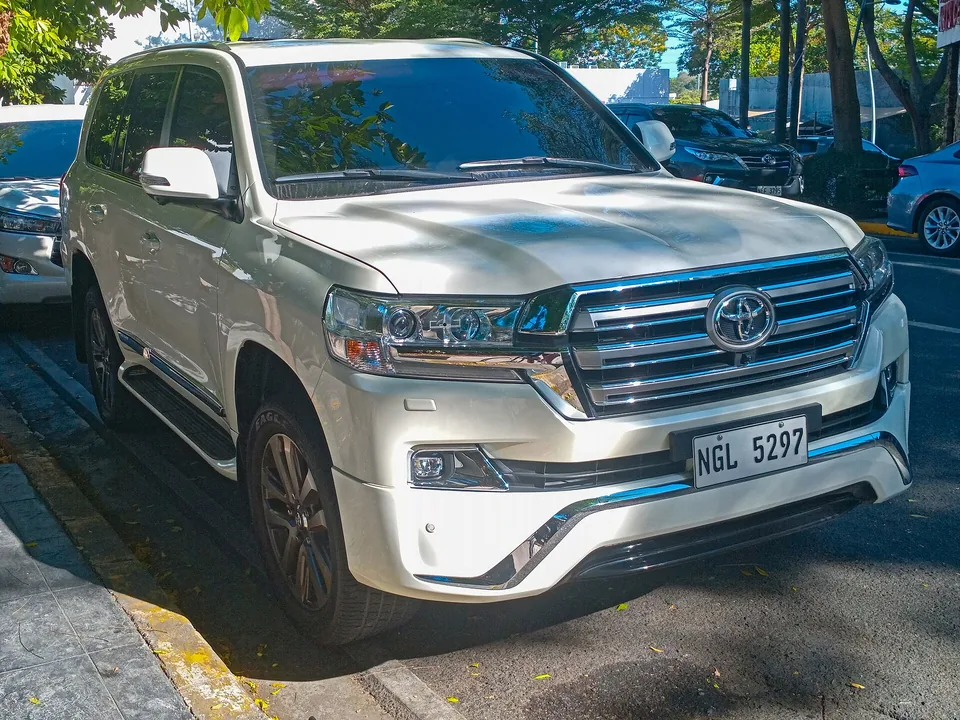
Toyota Land Cruiser (J200)
Why 9.3: A ladder-frame, full-time four-wheel-drive wagon Toyota engineered to a service life rather than a lease term, sold in the United States with a 5.7-litre V8 and everywhere else with a twin-turbo diesel. It is unexciting on purpose, and it is driven further and kept longer than almost anything else on this index.
Layout
Natural habitat
Ride comfort
Sound
The naturally aspirated V8 does produce a distant, muted burble under load and never sounds strained. But Toyota's brief was silence for 300,000 km, so the engine sits behind mounts and insulation and stops at 5,600 rpm. Deliberately, competently unremarkable.
8-cylinder · naturally aspirated · 5,600 rpm redline · rated 4.3 / 10 for engine sound
Market value
Median asking price, good condition · €59k (2008) → €57k (2026), trending down · illustrative data
Child seats · ISOFIX
Two ISOFIX positions on the outer rear seats, the outer pair being the ones the standard covers.
The rear anchors are the supported route — the manual points child seats there, and front-passenger ISOFIX is the exception rather than the rule. A belt-mounted seat up front needs the airbag off, and cars with a rear row don't always fit a deactivation switch, precisely because the rear seats exist.
Derived from production years and seating layout, not a per-car source. ISOFIX was standardised as ISO 13216 in 1997, required on new EU model types from 2011 and on all new EU cars from 2014.
The long version
The 200-series ran for fourteen years with one facelift, which tells you what it was for. Toyota's brief was the places where a recovery truck is not coming: aid fleets, mining roads, the Australian interior, the Gulf, and the American families who quietly bought them as the last large car they intended to own. The hardware follows — boxed ladder frame, Torsen centre differential, KDSS hydraulic anti-roll bars that decouple the suspension when the wheels start moving in opposite directions, and a naturally aspirated 5.7 rated to run for a very long time rather than to make a headline figure. That is why the ownership numbers look the way they do. Land Cruisers appear at the top of every survey of vehicles still on the road past 200,000 miles and of vehicles kept longest by their first owner, and the reason is not sentiment: the running costs are high, the fuel consumption is dismal, and nobody keeps one for a decade unless they are using it. There is one genuine speculative tail. Toyota withdrew the Land Cruiser from the United States after 2021, and clean late cars and the 2020 Heritage Edition briefly traded above their sticker — the only period in the model's history when buying one to sell one made sense. That behaviour is a rounding error against a fleet that is mostly out working, which is why the flip factor stays high rather than perfect.