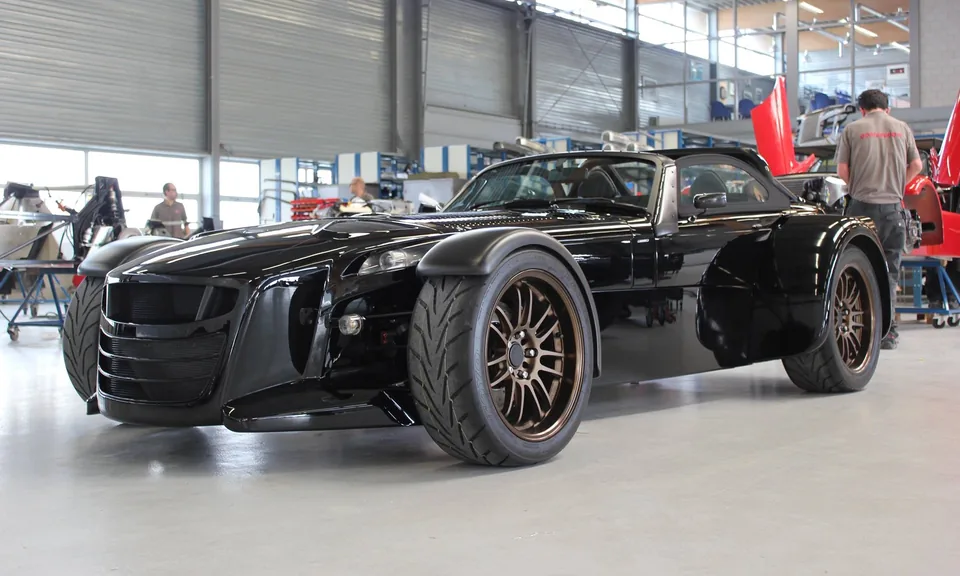
Donkervoort D8 GTO
Why 5.4: Donkervoort has built Seven-derived cars in the Netherlands since 1978, and the D8 GTO is where it stopped being a Caterham rival: Audi's 2.5-litre five-cylinder turbo, 340 hp as standard and 380 in Performance and RS form, in a 695 kg car with no power steering and no stability system to intervene.
Layout
Natural habitat
Ride comfort
Sound
Audi's 2.5 TFSI five-cylinder has the 1-2-4-5-3 firing order that gives it that off-beat warble, and at 695 kg with almost no insulation the Donkervoort broadcasts all of it. Turbocharging keeps it below the naturally aspirated screamers.
5-cylinder · turbocharged · 7,000 rpm redline · rated 7.9 / 10 for engine sound
Market value
Median asking price, good condition · €161k (2013) → €216k (2026), trending up · illustrative data
Child seats · ISOFIX
There aren't any — strict two-seater.
No anchors, and on most of these no passenger airbag either — the car is too stripped for the question to arise. Whatever goes in that seat goes in on a harness or a belt.
Derived from production years and seating layout, not a per-car source. ISOFIX was standardised as ISO 13216 in 1997, required on new EU model types from 2011 and on all new EU cars from 2014.
The long version
Every D8 GTO is built to order in Lelystad by a company that has never made more than a few dozen cars in a year, and that is the first fact about owning one. The construction is a hybrid: a tubular steel frame bonded to large carbon composite panels, which is where both the rigidity and the weight figure come from, wrapped in cycle-winged bodywork over an enormously wide track, with butterfly doors. The engine is the five-cylinder turbo from an Audi RS 3, in a car around half the weight, and Donkervoort has quoted lateral grip beyond 2 g on road tyres — with nothing electronic standing between that and the driver. It ran from 2013 to 2022 in Touring, Performance, S and RS forms plus a run of numbered specials, and in July 2022 it went on sale in the United States for the first time in the marque's history, through a Florida importer at $240,000 — so the obvious assumption about a small Dutch manufacturer turns out to be wrong by a matter of months. Ownership behaves as the build process implies: annual mileage is low, retention is very high because a car specified over months is a personal object rather than a trade, and a real share of the distance covered happens at track days and on the factory's own owner events.