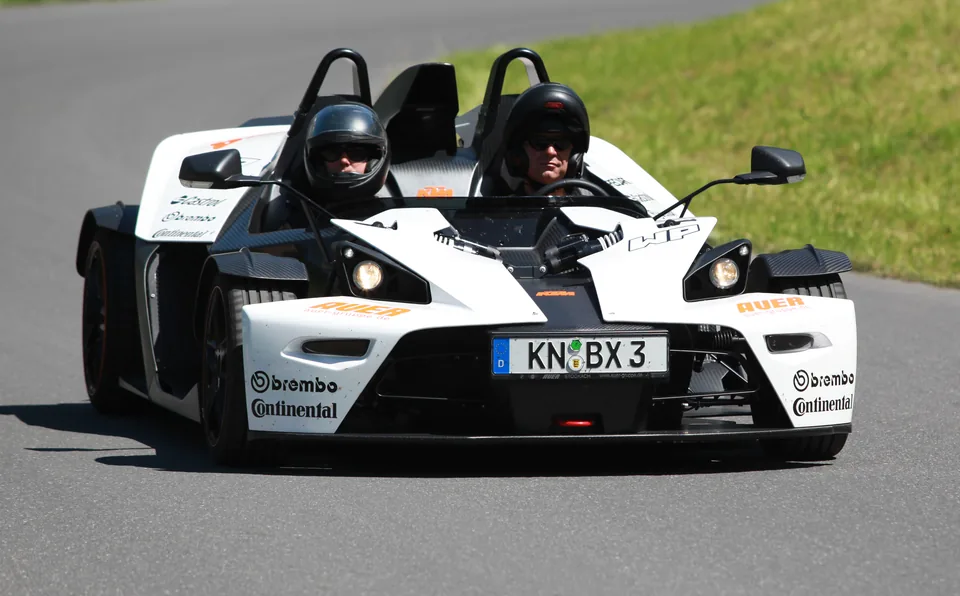
KTM X-Bow
Why 4.7: A motorcycle company's first car, engineered with Dallara around a full carbon-fibre monocoque at a price nobody had managed for that construction before, with a Volkswagen Group 2.0 TFSI behind the seats and pushrod suspension at both ends. Everything else was deleted: roof, doors, windscreen, power steering.
Layout
Natural habitat
Ride comfort
Sound
With no roof, no windscreen and barely any bodywork, the Audi 2.0 TFSI sits exposed behind your head and every intake and wastegate event reaches you. But it is a hatchback engine: a turbo four to 6,500 rpm with no character of its own.
4-cylinder · turbocharged · 6,500 rpm redline · rated 5.8 / 10 for engine sound
Market value
Median asking price, good condition · €82k (2008) → €69k (2026), trending down · illustrative data
Child seats · ISOFIX
There aren't any — strict two-seater.
No anchors, and on most of these no passenger airbag either — the car is too stripped for the question to arise. Whatever goes in that seat goes in on a harness or a belt.
Derived from production years and seating layout, not a per-car source. ISOFIX was standardised as ISO 13216 in 1997, required on new EU model types from 2011 and on all new EU cars from 2014.
The long version
KTM had built motorcycles for sixty years when the X-Bow appeared at Geneva in 2007, and the point of it was the tub — a full carbon monocoque, produced by Wethje and engineered with Dallara, in a car that opened around €50,000 rather than the several hundred thousand a carbon chassis normally implied. Everything else is subtraction: 790 kg with an Audi-sourced 2.0 TFSI making 240 hp at launch and 300 hp in the R, no roof, no doors, no windscreen on the base cars, and nothing between the driver and the weather but a helmet. That specification decides how the car is owned. An X-Bow is a second or third vehicle, it comes out when the road and the forecast agree, and a large share of its annual mileage happens at a circuit — which is how one car ends up with the highest track-day score on this site and one of the lowest mileage scores at the same time. It has been sold in America since 2019, but only as the track-only Comp R, never federalised for the road, which is a distinction worth making before anyone reaches for the Forbidden Fruit label. Values fell hard through the 2010s and have firmed since the GT-XR revived the brand's road-car story.