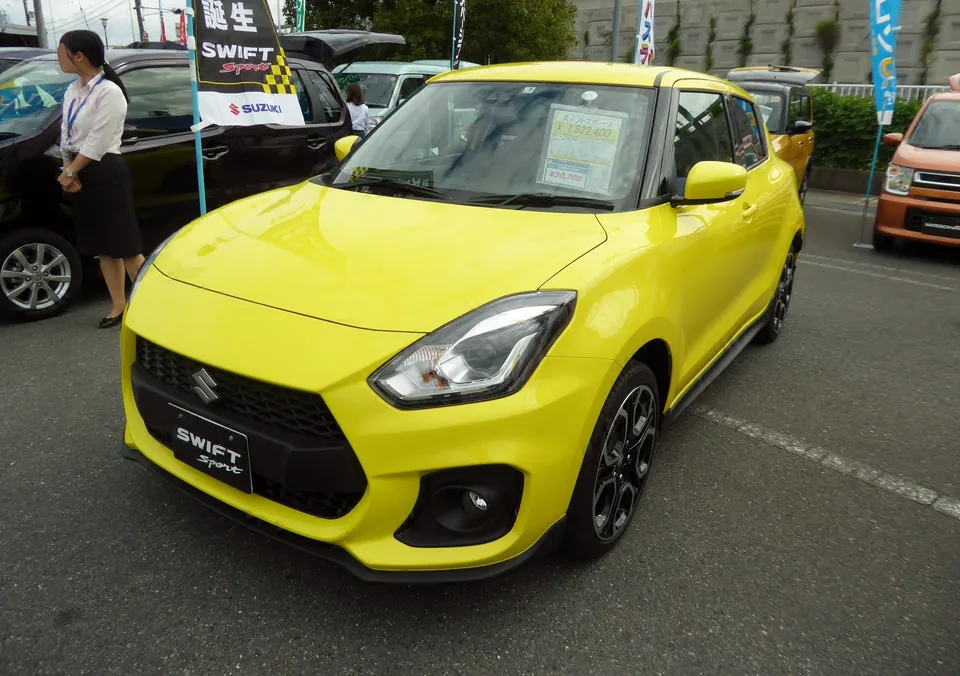
Suzuki Swift Sport (ZC33S)
Why 8.0: Suzuki put the Vitara's 1.4-litre turbo into a Swift that weighs 970 kg — lighter than a Mk1 Golf GTI — and let the ratio do the work rather than chase a headline power figure. 230 Nm from 2,500 rpm in a car this light is a different sort of quick from a 300 hp hatchback, at roughly a third of the money.
Layout
Natural habitat
Ride comfort
Sound
The 1.4 Boosterjet is willing and the light body means induction noise carries further than usual. But it is among the quietest hot hatches sold: heavily silenced, 6,500 rpm, no valve, no theatre. The 970 kg is the reason to buy it, not this.
4-cylinder · turbocharged · 6,500 rpm redline · rated 4.2 / 10 for engine sound
Market value
Median asking price, good condition · €20k (2018) → €13k (2026), trending down · illustrative data
Child seats · ISOFIX
Two ISOFIX positions on the outer rear seats, the outer pair being the ones the standard covers.
The rear anchors are the supported route — the manual points child seats there, and front-passenger ISOFIX is the exception rather than the rule. A belt-mounted seat up front needs the airbag off, and cars with a rear row don't always fit a deactivation switch, precisely because the rear seats exist.
Derived from production years and seating layout, not a per-car source. ISOFIX was standardised as ISO 13216 in 1997, required on new EU model types from 2011 and on all new EU cars from 2014.
The long version
The ZC33S is the fourth Swift Sport and the first with a turbocharger, which cost it the old car's willingness to rev and bought it torque everywhere below 5,000 rpm. The number Suzuki barely advertised is the one that matters: 970 kg, achieved on the Heartect platform through a genuine effort to leave things out, in a decade when every rival put 200 kg on. It drives the way hot hatches did before electronic differentials and nineteen-inch wheels — soft by class standards, generous with roll, and completely legible at the speeds a public road allows, which is rarer than another tenth to 60. Suzuki has not sold cars in the United States since 2012 and no Swift Sport of any generation was ever offered there, so the entire American conversation about this car is hypothetical. Everywhere else it is a cheap, reliable, well-supported daily that people buy new and keep for years, which is why it turns up in traffic rather than at auction. A mild-hybrid version arrived in 2020 and a Final Edition closed the model out.