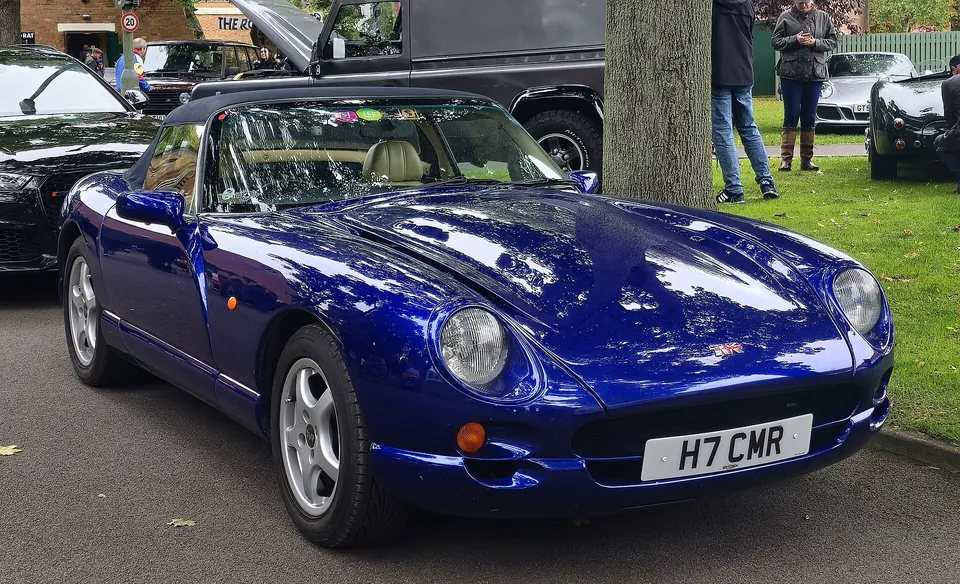
TVR Chimaera
Why 7.0: TVR's tourer: the Griffith's backbone chassis and Rover V8 in a longer, roomier body with softer springs, built for eleven years and 5,256 cars — high volume by TVR standards, and the reason these stayed affordable. Between 240 and 340 hp in a 1,060 kg roadster with no ABS and no traction control, cheap enough that the ownership base is mechanically involved by necessity rather than by choice.
Layout
Natural habitat
Ride comfort
Sound
TVR barely silenced the Rover V8 at all, and the side exits give a bassy blare with cracks on the overrun few road cars match. But it is a two-valve pushrod V8 stopping at 6,000 rpm, so there is nothing above the bark — all attack, no climb.
8-cylinder · naturally aspirated · 6,000 rpm redline · rated 7.4 / 10 for engine sound
Market value
Median asking price, good condition · €46k (1996) → €35k (2026), trending down · illustrative data
Child seats · ISOFIX
There aren't any — strict two-seater.
The only position there is — and the weak point of this era. Airbag cut-off switches only became routine in the mid-2000s; many of these cars have none from the factory, which rules out a rear-facing seat entirely unless a dealer-fitted deactivation was installed. Forward-facing on the belt, seat slid fully back, is what the period manuals allow.
Derived from production years and seating layout, not a per-car source. ISOFIX was standardised as ISO 13216 in 1997, required on new EU model types from 2011 and on all new EU cars from 2014.
The long version
First shown at the 1992 Earl's Court Motor Show, the Chimaera was meant to replace the Griffith and instead sold alongside it for a decade because demand for both held up. It used the same backbone chassis and the same Rover V8 derivatives, but stretched the body, found luggage space and softened the suspension — TVR's attempt at a long-distance car rather than a short-tempered one. Engine choice ran from the 4.0 at 240 hp through 4.3, 4.5 and the 5.0-litre Chimaera 500 at 340 hp, all manual, all with no anti-lock brakes, no traction control and no airbags, because Peter Wheeler did not believe in fitting them. At 5,256 cars it is among the highest-volume TVRs ever built, and that volume is why the model never became precious: parts exist, specialists exist, and prices spent two decades on the floor. The result is an ownership base that drives them — a Chimaera bought at £15,000 owes nobody a preservation duty — and a slow, unspectacular value recovery driven by the scarcity of good cars rather than by speculation. It is the least intimidating way into a 1990s TVR and, not coincidentally, the one most likely to be out on a Sunday.