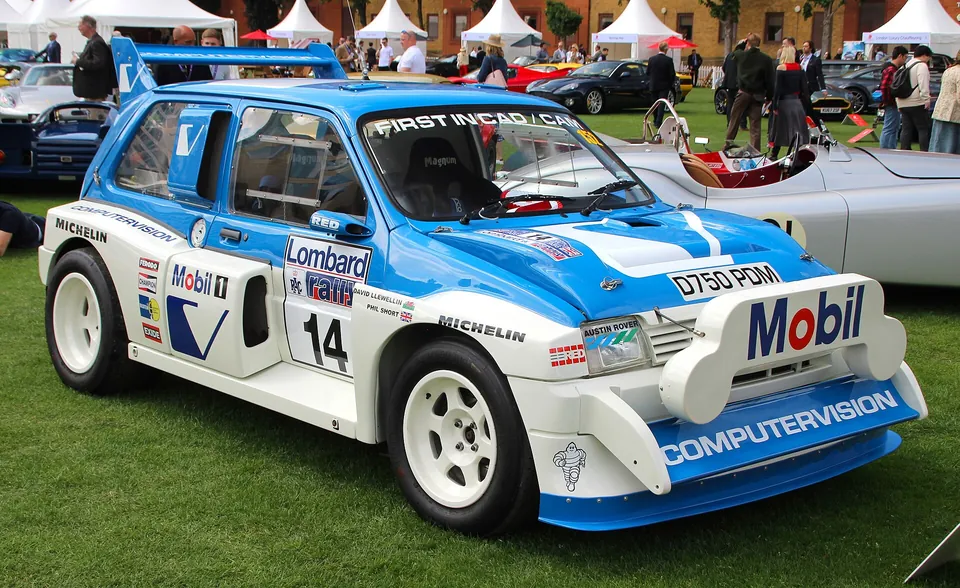
MG Metro 6R4
Why 3.7: Austin Rover handed the project to Williams Grand Prix Engineering and got back a mid-engined, permanently four-wheel-drive homologation special sharing nothing with the shopping Metro but a silhouette. Alone in Group B it was naturally aspirated — a bespoke 3.0-litre V6 borrowing Cosworth DFV architecture, 250 bhp in the 200 road-legal Clubman cars, over 410 bhp and a 9,000 rpm limit in International trim. Almost no road miles, but historic rallying and rallycross keep the survivors genuinely competing.
Layout
Natural habitat
Ride comfort
Sound
The only Group B car without a turbo: a quad-cam 24-valve V6 on straight-cut gears with a barely silenced side exit, and it is still the loudest thing on any rally stage. It falls short of the exotics only because the V64V was built to win, not to sing.
6-cylinder · naturally aspirated · 7,000 rpm redline · rated 8.6 / 10 for engine sound
Market value
Median asking price, good condition · €46k (1986) → €239k (2026), trending up · illustrative data
Child seats · ISOFIX
Built before ISOFIX existed, so there are no anchor points at all. A child seat here is a seatbelt installation in the only passenger seat there is.
Derived from production years and seating layout, not a per-car source. ISOFIX was standardised as ISO 13216 in 1997, required on new EU model types from 2011 and on all new EU cars from 2014.
The long version
The name spells out the specification — six cylinders, rally, four-wheel drive — and almost nothing else about the car came from the Metro it was named after. Williams Grand Prix Engineering built a seam-welded tubular semi-monocoque, mounted David Wood's bespoke V6 backwards behind the cabin with the gearbox in the middle of the car, and ran permanently engaged four-wheel drive through separate propshafts front and rear. Every serious rival in Group B used forced induction; Austin Rover did not, which cost the 6R4 outright power but gave it throttle response nothing turbocharged could match and a noise that is still the first thing anyone mentions. Two hundred Clubman cars were built to homologate it, at 250 bhp and roughly 1,000 kg, and the works Internationals ran past 410 bhp — then the FIA cancelled Group B at the end of 1986 and the programme was finished almost before it started. What happened next is why this scores differently from a Delta S4 or an 037 Stradale: the leftover cars and their spare engines were cheap enough to pour into British rallycross and club rallying rather than into collections, and a one-make MG Metro Super Challenge ran through 1988 and 1989. Values have since climbed into serious money and road mileage is effectively zero, but these still turn up on start lines rather than only on lawns — a genuinely unusual ownership pattern for a Group B survivor.