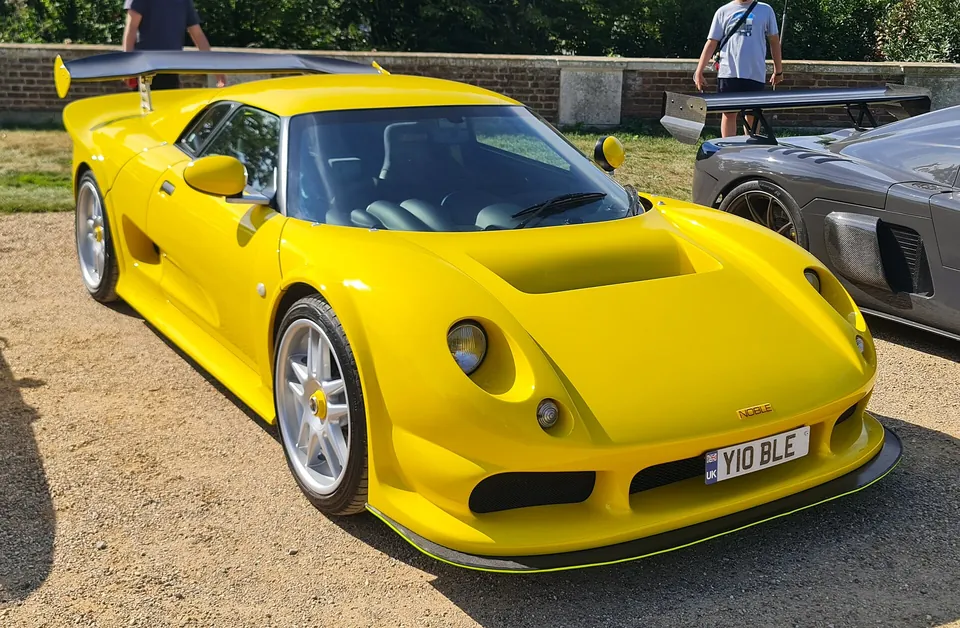
Noble M12
Why 6.3: Lee Noble's steel-spaceframe, glassfibre-bodied coupe with a twin-turbocharged Ford Duratec V6 behind the seats — 310 hp in the original GTO, 352 hp in the GTO-3 and GTO-3R, all in 1,080 kg with no ABS and no traction control. One of the very few Nobles ever officially sold in America, and bought by people who read the road tests rather than the brochure.
Layout
Natural habitat
Ride comfort
Sound
With no insulation anywhere you hear the turbos spool, the wastegates dump and the plenum breathe, all from a foot behind your head. But the engine underneath is a Ford Duratec V6, and the turbos flatten what little note it has into whoosh.
6-cylinder · turbocharged · 7,000 rpm redline · rated 6.4 / 10 for engine sound
Market value
Median asking price, good condition · €78k (2003) → €87k (2026), trending up · illustrative data
Child seats · ISOFIX
There aren't any — strict two-seater.
The only position there is — and the weak point of this era. Airbag cut-off switches only became routine in the mid-2000s; many of these cars have none from the factory, which rules out a rear-facing seat entirely unless a dealer-fitted deactivation was installed. Forward-facing on the belt, seat slid fully back, is what the period manuals allow.
Derived from production years and seating layout, not a per-car source. ISOFIX was standardised as ISO 13216 in 1997, required on new EU model types from 2011 and on all new EU cars from 2014.
The long version
Noble Automotive designed and engineered the M12 in Leicestershire and had it built in Port Elizabeth by Hi-Tech Automotive, a supply chain that tells you most of what you need to know about the company's scale. Underneath sits a full steel roll cage and spaceframe with glassfibre composite panels, and behind the cabin a transversely mounted Ford Duratec V6 with a pair of Garrett T25 turbochargers — 2.5 litres and 310 hp at 6,000 rpm in the original GTO, 3.0 litres and 352 hp at 6,200 rpm from the GTO-3 onward. It weighs 1,080 kg, has no anti-lock brakes, no traction control and no stability system, and the British magazines of the early 2000s spent years writing that it out-handled cars costing three times as much. Only 220 GTO-3Rs and M400s were ever officially imported to the United States, making this one of the rare British specialists Americans could buy new, and the US production rights later passed to 1G Racing in Ohio, whose Rossion Q1 is an evolved M400. Nobody buys one of these for the badge, because there isn't one worth having — which filters the ownership down to drivers, keeps track use high and speculation low, and is why values dipped and then recovered on genuine demand rather than on hype.