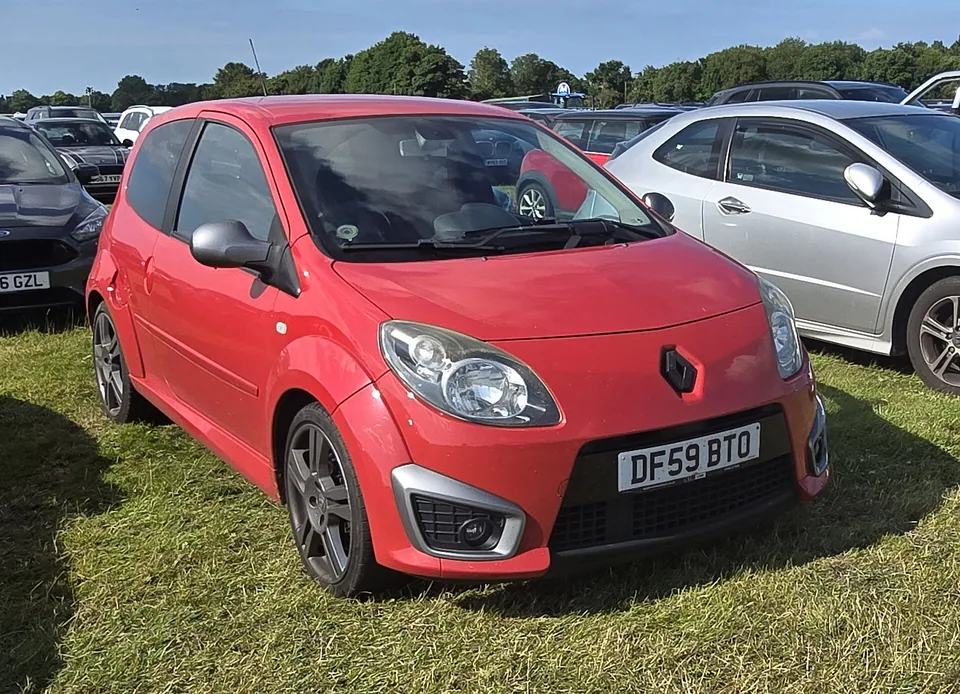
Renault Twingo RS
Why 8.1: Renault Sport put a naturally aspirated 133 PS 1.6 and its own chassis under a car that cost about half what a Clio 197 did. The optional Cup pack drops it a further 4 mm on ten per cent stiffer springs and adds 17-inch wheels, which is more change than most manufacturers manage between whole model years.
Layout
Natural habitat
Ride comfort
Sound
No turbocharger anywhere, so the 1.6 pulls cleanly to 7,000 rpm and the induction reaches you through a shell with very little in it. But this is the smallest engine Renault Sport ever put its name to, and it thrashes where the Clio's two litres snarl. You rev it because it gives you no choice, not because the noise repays it.
4-cylinder · naturally aspirated · 7,000 rpm redline · rated 5.4 / 10 for engine sound
Market value
Median asking price, good condition · €20k (2009) → €10k (2026), trending down · illustrative data
Child seats · ISOFIX
Two ISOFIX positions on the outer rear seats, the outer pair being the ones the standard covers.
The rear anchors are the supported route — the manual points child seats there, and front-passenger ISOFIX is the exception rather than the rule. A belt-mounted seat up front needs the airbag off, and cars with a rear row don't always fit a deactivation switch, precisely because the rear seats exist.
Derived from production years and seating layout, not a per-car source. ISOFIX was standardised as ISO 13216 in 1997, required on new EU model types from 2011 and on all new EU cars from 2014.
The long version
By 2008 the hot hatch was already drifting upmarket, and the Twingo RS is the last time Renault Sport built something genuinely small and genuinely cheap. There is no turbocharger, which in that decade was almost a political statement: 133 PS from 1.6 naturally aspirated litres means it does nothing at all below 4,000 rpm and everything above it, and the five-speed gearbox exists to keep you there. The chassis is the part people underestimated at the time and have since gone looking for — Renault Sport Technologies tuned it properly, and evo's advice by the end was to buy the standard car rather than the Cup, because the extra compliance is what makes it work on a real road. A Gordini version arrived in 2010 with the blue paint and white stripes, and ordering closed in August 2013. Nothing replaced it: the third-generation Twingo went rear-engined on a Smart platform and never got an RS badge at all, so this is the end of a line rather than a chapter in one. They depreciated to almost nothing and stayed there long enough to be bought as first performance cars and used up, which is exactly what the ownership numbers show.