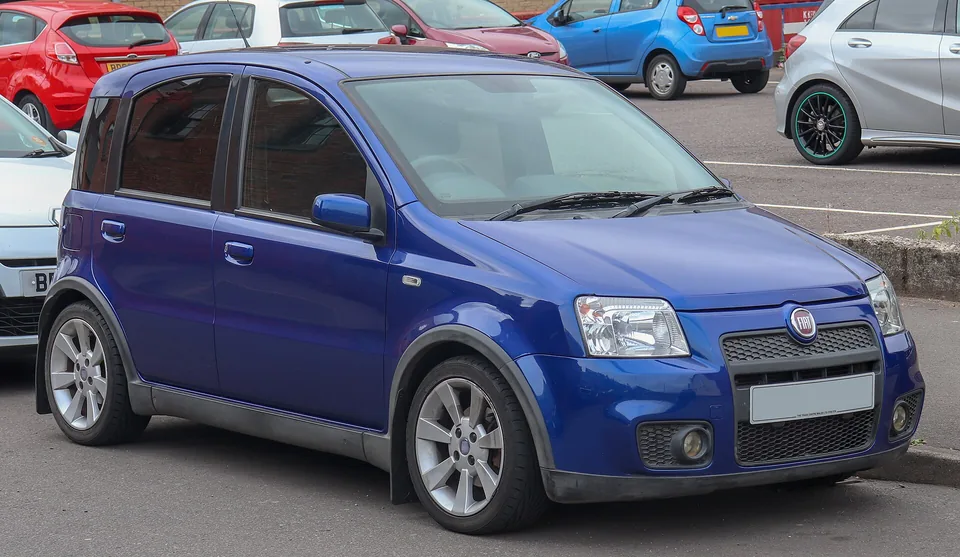
Fiat Panda 100HP
Why 8.5: Fiat took the cheapest thing it sold, gave it 100 PS, a six-speed gearbox, discs at all four corners and its own springs, dampers and bushes, and left it looking almost exactly like the shopping car underneath. At 975 kg it did not need much more than that.
Layout
Natural habitat
Ride comfort
Sound
The 1.4 FIRE is willing and there is very little sound deadening in a car built to this price, so you hear it work. But it is a Punto engine on a standard silencer, out of ideas by 6,000 rpm, and much of what reaches you is road roar off the 15-inch wheels. The chassis is the reason to buy this, not the noise.
4-cylinder · naturally aspirated · 6,500 rpm redline · rated 4.6 / 10 for engine sound
Market value
Median asking price, good condition · €14k (2006) → €8k (2026), trending down · illustrative data
Child seats · ISOFIX
Two ISOFIX positions on the outer rear seats, the outer pair being the ones the standard covers.
The rear anchors are the supported route — the manual points child seats there, and front-passenger ISOFIX is the exception rather than the rule. A belt-mounted seat up front needs the airbag off, and cars with a rear row don't always fit a deactivation switch, precisely because the rear seats exist.
Derived from production years and seating layout, not a per-car source. ISOFIX was standardised as ISO 13216 in 1997, required on new EU model types from 2011 and on all new EU cars from 2014.
The long version
The second-generation Panda was designed to be a two-million-unit city car and the 100HP is the version that admits nothing of the sort. The 1.4-litre sixteen-valve FIRE engine makes 100 PS at 6,000 rpm and 131 Nm at 4,250, which on paper is 9.5 seconds to 100 km/h and 185 km/h flat out — unremarkable numbers that miss the point entirely. What matters is that the suspension is genuinely unique to this model rather than a badge and a set of wheels, that it is tall and short and eager to rotate the moment you lift, and that all of it is happening at speeds you can actually use. Fiat stopped building it in July 2010 because tightening emissions rules made a naturally aspirated 1.4 indefensible, and nothing since has replaced it — the hot supermini moved upmarket, gained a turbocharger and put on 300 kg. Prices bottomed out around scrap value in the late 2010s and have only recently started to move, because these were bought as first cars and cheap runabouts and used exactly that way. That is the whole reason this scores where it does: nobody has ever parked one.